Are bottles jamming, tipping, or entering your filling machine at irregular intervals? A worn or incorrectly designed feed screw may be causing inconsistent container movement.
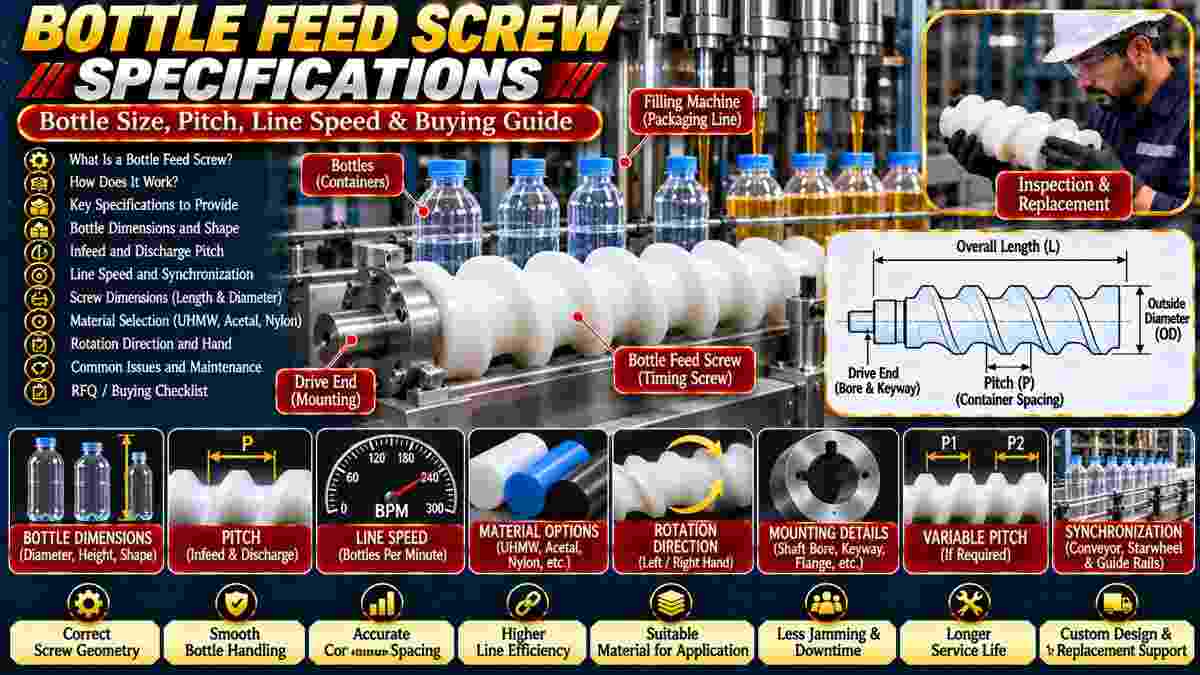
Bottle feed screw specifications should include container dimensions, pocket geometry, infeed and discharge pitch, line speed, screw length, material, rotation direction, and mounting requirements.
These details help manufacturers evaluate a compatible replacement or custom-designed component.
Asar Engineering Pvt. Ltd. manufactures feed screws to customer drawings or samples for industrial and packaging machinery.
What Is a Bottle Feed Screw?
A bottle feed screw, also called a timing screw or scroll, is a rotating profiled component that spaces, guides, and positions containers on automated packaging lines.
Common applications include:
Explore Feed Screws for product information.
How Does a Bottle Timing Screw Work?
A bottle timing screw uses specially shaped pockets to capture incoming containers and move them at controlled intervals.
As the screw rotates, each pocket guides a container forward.
The screw helps establish the spacing required by downstream equipment.
Its operation must be coordinated with conveyor movement, guide rails, and any transfer starwheel.
Why Are Bottle Feed Screw Specifications Important?
Accurate specifications help ensure smooth container handling and compatibility with the existing packaging machine.
Incorrect screw geometry can contribute to:
A replacement should be evaluated against both the container and the packaging machine.
How Do Bottle Dimensions Affect Feed Screw Design?
Bottle dimensions determine the pocket geometry and clearances needed to guide each container without excessive contact pressure.
Important information includes:
Round bottles, rectangular containers, and irregularly shaped packages may require different screw profiles.
Why Is Bottle Shape Important?
Bottle shape affects how the container enters, contacts, and moves through the timing screw.
A cylindrical bottle generally behaves differently from a square or tapered container.
Unstable bottles may require additional support from guide rails or other handling components.
Provide a physical sample or accurate 3D model when ordering a custom screw.
What Is Pitch in a Bottle Feed Screw?
Pitch is the axial distance between corresponding positions in consecutive timing-screw pockets.
The required pitch depends on container dimensions and downstream machine spacing.
Some timing screws use variable pitch to separate closely grouped bottles progressively.
Different sections of the same screw may therefore have different pocket spacing.
How Do You Determine the Correct Infeed and Discharge Pitch?
Infeed pitch should accommodate how containers arrive, while discharge pitch must match the required spacing at the next machine.
Important requirements include:
-
Incoming container spacing.
-
Conveyor speed.
-
Required discharge spacing.
-
Starwheel pocket spacing.
-
Product flow direction.
-
Timing relationship with downstream equipment.
Incorrect discharge pitch can cause poor handoff between the screw and the next machine.
How Does Packaging Line Speed Affect Screw Selection?
Packaging line speed determines the required container handling rate and influences screw rotational speed and synchronization.
Specify:
-
Normal bottles per minute.
-
Maximum intended line speed.
-
Conveyor operating speed.
-
Screw drive speed.
-
Starting and stopping behavior.
-
Required timing accuracy.
A screw designed for one operating range may not perform correctly at significantly different speeds.
Which Bottle Feed Screw Dimensions Should You Provide?
Important dimensions include overall length, active pocket length, outside diameter, root diameter, and drive-end geometry.
Record:
An approved drawing or original sample helps establish replacement dimensions.
Why Is Rotation Direction Important?
Rotation direction determines how the helical pockets move containers along the packaging line.
Buyers should identify the required screw hand and direction of rotation.
The relationship between screw rotation, conveyor travel, and container flow must be verified.
Incorrect handedness can make the replacement incompatible with the existing equipment.
Which Materials Are Suitable for Bottle Feed Screws?
Material selection depends on container properties, friction, hygiene requirements, wear, and the operating environment.
Common options include:
Engineering plastics are frequently used because their surface characteristics can suit container-handling applications.
Confirm material suitability for chemicals, cleaning procedures, and operating conditions.
How Do Guide Rails Affect Timing Screw Performance?
Guide rails help maintain container positioning as bottles enter and travel along the timing screw.
Incorrect rail clearance or alignment may lead to tipping, scuffing, or jamming.
The screw and guide system must be evaluated together.
Changes to bottle dimensions may require guide-rail adjustments in addition to a new screw.
What Causes Bottle Feed Screw Jamming?
Common causes include incorrect pocket geometry, worn screw surfaces, poor alignment, excessive infeed pressure, and synchronization errors.
Warning signs include:
-
Repeated container collisions.
-
Bottles becoming trapped.
-
Uneven gaps.
-
Damaged labels.
-
Unusual vibration.
-
Irregular transfer to starwheels.
Inspect the complete conveyor and transfer system before replacing the screw.
When Should You Replace a Bottle Timing Screw?
Replacement may be necessary when wear or damage prevents the screw from maintaining the required bottle spacing and positioning.
Check for worn pockets, cracks, deformation, damaged mounting interfaces, and repeated handling failures.
Confirm that the problem is not caused by unrelated conveyor or alignment issues.
Can One Feed Screw Handle Different Bottle Sizes?
Some designs can accommodate limited container variation, but major changes in diameter, shape, or spacing may require another screw profile.
Before changing bottle sizes, compare the new container's dimensions with the approved screw geometry.
A change-part evaluation or production trial may be necessary.
What Factors Affect Bottle Feed Screw Prices?
Prices depend on screw length, material, pocket complexity, precision requirements, and production quantity.
Other factors include CAD development, sample inspection, machining, and special mounting features.
Compare quotations using the same component specifications.
What Should You Include in a Bottle Feed Screw RFQ?
A complete quotation request should describe the container, packaging machine, screw geometry, operating speed, and installation requirements.
Provide:
-
Packaging machine manufacturer and model.
-
Filling, capping, labeling, or transfer application.
-
Bottle dimensions and shape.
-
Container material and weight.
-
Normal and maximum line speed.
-
Required infeed and discharge pitch.
-
Screw outside and root diameters.
-
Overall and working lengths.
-
Rotation direction and screw hand.
-
Shaft bore, keyway, and mounting details.
-
Preferred screw material.
-
Drawings or samples, quantity, and delivery location.
For custom designs, provide information about the guide rails and downstream starwheel.
Why Should Buyers Consider Asar Engineering?
Asar Engineering manufactures feed screws to customer drawings or samples, including timing screws used for packaging applications.
Its product information covers custom screw profiles, material selection, container positioning, and manufacturing requirements.
Explore Feed Screws for relevant product details.
Confirm achievable tolerances, material options, technical documentation, and availability before ordering.
What Are the Most Frequently Asked Questions About Bottle Feed Screws?
Common questions concern pitch, materials, replacement compatibility, and packaging line performance.
Are Bottle Feed Screws and Timing Screws the Same?
The terms are often used interchangeably in packaging machinery, although the exact function depends on the application.
Can Bottle Feed Screws Be Custom Manufactured?
Yes. Custom geometry may be developed from container specifications, approved drawings, and machine requirements.
Does Incorrect Pitch Cause Bottle Jamming?
It can. Incorrect pocket spacing may interfere with container movement or downstream machine synchronization.
Can a Bottle Feed Screw Be Made From Nylon?
Yes. Nylon and other engineering plastics may be suitable depending on the application.
Is a Physical Bottle Sample Necessary?
A sample is helpful for unusual container profiles, although accurate drawings or 3D models may also support design evaluation.
How Can You Request Bottle Feed Screws From Asar Engineering?
You can request a quotation by sharing your packaging machine details, bottle dimensions, feed screw measurements, required spacing, line speed, and quantity.
For replacement parts, include the existing screw drawing, photographs, or a physical sample.
Explore Feed Screws or contact Asar Engineering to discuss your requirements.
Technical Note: Final feed screw geometry, material selection, tolerances, and synchronization should be validated against approved packaging machine specifications and production requirements.