Rack And Pinion Manufacturers in India
Racks and Pinions made to your drawing or sample at our Gujarat unit, supplied across India and exported.

Asar Engineering Pvt. Ltd. Gandevi, Gujarat
- Teeth cut in-house: hobbing, shaping and spiral bevel cutting
- Induction hardening done in-house
- Made to your drawing or a worn sample
- Supplied across India and exported (IEC registered)
Gear Racks and Pinions for Linear Motion
Asar Engineering is a rack and pinion manufacturer in India, cutting racks on CNC rack-cutting machines and pinions on gear hobbing machines at its unit in Gandevi, Gujarat. A rack and pinion has two mating parts: a round gear called the pinion and a straight toothed bar called the rack. Together they convert rotary motion into linear motion, or linear motion back into rotary motion.
Most gear pairs transfer rotation from one shaft to another. A rack and pinion instead turns the rotation of the pinion into straight-line travel of the rack. This makes it useful wherever a machine needs linear positioning, lifting or controlled travel along a fixed path.
We make racks and pinions to customer drawing or sample, matched to rack length, module, tooth profile, pinion size, material, load, travel, speed and mounting. Teeth can be induction hardened in-house where wear resistance is needed.
Rack and pinion drives are used in CNC machines and cutting tables, automation equipment, lifting mechanisms, gate hoists, construction hoists, steering systems and rack railways. Their simple construction and direct tooth engagement make them an effective way to turn rotary input into accurate linear movement.
What is a Rack and Pinion?
A rack and pinion is a mechanism that turns rotary motion into linear motion, or linear motion into rotary motion, using a round pinion meshing with a straight toothed rack.
The pinion is an ordinary spur or helical gear with teeth around its circumference, while the rack is a straight bar with teeth along its length. As the pinion rotates, its teeth push the rack along its length, or drive the pinion and its carriage along a fixed rack.
For every full turn of the pinion, the rack moves a distance equal to the pitch circle circumference of the pinion, that is π × module × number of teeth (in the transverse plane for helical teeth). The direction of travel follows the direction of rotation.
Rotary to Linear Motion
The most common operating principle is the conversion of rotary motion into linear motion.
When an external force rotates the pinion, its teeth push against the teeth on the rack. Instead of rotating around an axis, the rack travels along a straight path.
This principle is used in CNC machines, linear positioning systems, lifting mechanisms and vehicle steering.
Linear to Rotary Motion
The mechanism can also work in reverse. When an external force moves the rack along its length, the rack teeth push against the pinion teeth and cause the pinion to rotate.
This is useful where linear movement must drive a rotating part, for example in some measuring devices and door or gate mechanisms.
Rack Travel
Unlike a conventional circular gear that can continue rotating around its shaft, a rack has a finite physical length. The available linear travel is therefore limited by the length of the rack and the mechanical arrangement of the system.
For long travel, several rack sections are joined end to end. The joints must keep the correct tooth pitch across the butt faces, which is usually done with a gauge piece during mounting, so the pinion runs smoothly from one section to the next.
Tooth Engagement
The rack and pinion must have the same module (or diametral pitch), pressure angle and, for helical teeth, the same helix angle of opposite hand, to mesh correctly.
Accurate matching spreads the load properly and avoids problems such as excess backlash, tooth interference and uneven wear.
Straight-Tooth Design
Straight or spur-type rack and pinion systems use teeth arranged perpendicular to the direction of rack travel.
This design is simple to make and install. It is widely used where moderate speeds, straightforward construction and low cost matter.
Helical-Tooth Design
Helical rack and pinion systems use teeth positioned at an angle relative to the rack's direction of movement.
Because the teeth engage progressively rather than across the full face at once, helical racks give smoother, quieter movement and more teeth in contact, which helps load capacity.
Helical teeth also produce an axial (sideways) force, so the pinion bearings and rack mounting must be designed to take this thrust.
Backlash
Backlash is the small clearance between mating rack and pinion teeth. Some clearance is needed for lubrication, thermal expansion and small mounting errors.
In positioning drives, too much backlash reduces accuracy. Rack and pinion drives on CNC and automation equipment often use an adjustable pinion mounting or a twin-pinion preloaded arrangement to control it.
Applications of Rack and Pinion
Rack and pinion drives are used wherever a machine needs to turn rotary movement into controlled linear travel, or linear movement back into rotation.
Their simple geometry and direct tooth engagement suit both industrial machinery and lifting equipment.
Steering Mechanisms
The best-known example is rack-and-pinion steering in cars. Turning the steering wheel rotates a pinion, which moves a horizontal rack left or right; tie rods at the rack ends turn the front wheels.
Automotive steering gears are made by specialist component makers. The same principle, however, is used in industrial steering and positioning mechanisms, for which racks and pinions can be made to drawing.
CNC Machines, Cutting Tables and Routers
Rack and pinion drives move the gantry or carriage on CNC laser cutters, plasma tables, routers and other machines with long axes.
The pinion runs along a fixed rack to move the carriage. This suits long travel, where a leadscrew or ballscrew of the same length would whip or become too expensive.
Material Handling and Transfer Systems
Transfer cars, shuttles, stacker mechanisms and pallet changers use rack and pinion drives for positive, non-slip travel.
Because the drive is positive, the moving unit stops where it is commanded, even under varying load.
Sluice and Gate Lifting
Rack-type lifting gear is used on sluice gates, canal gates and industrial dampers, where a hand wheel or motor turns the pinion to raise and lower the gate.
These racks are usually heavy-module and run slowly, so tooth strength and resistance to corrosion matter more than smoothness.
Steel Plant and Mill Equipment
Rolling mill manipulators, tilting and pushing mechanisms and other heavy equipment in steel plants use large-module racks and pinions to carry high forces over short strokes.
Rack Railways
Rack railways use a specialized rack rail positioned between the normal running rails. A cogged pinion on the locomotive meshes with this rack to provide additional traction.
This arrangement allows trains to operate on steep gradients where ordinary wheel-and-rail adhesion would not provide sufficient traction.
Construction Hoists
Rack-and-pinion mechanisms are used in certain construction hoists to provide controlled vertical movement.
A motor-driven pinion on the cage meshes with a fixed rack along the mast, so the cage climbs and descends the structure. Hoist racks and pinions are safety-critical and must be designed to the applicable lift standards.
Lifting Equipment
Rack and pinion mechanisms can be incorporated into mechanical lifting systems where controlled linear displacement is required.
The ratio and rack size are chosen for the lifting force and stroke required.
Mechanical Jacks
Rack jacks use a pinion, turned by a handle through a ratchet or gear train, to raise a toothed rack and lift the load.
Industrial Automation
Production equipment uses rack and pinion drives for positioning, indexing, door and gate opening, transfer systems and other controlled linear movements.
Common Types of Rack and Pinion
Rack and pinion drives are grouped by tooth form, accuracy, duty and mounting. The main tooth forms are straight and helical.
Straight Rack and Pinion
A straight rack and pinion uses straight teeth arranged along the rack and around the pinion.
The design is simple and economical to make. It suits moderate speeds and straightforward machines.
Helical Rack and Pinion
A helical rack and pinion uses angled teeth to create gradual tooth engagement.
It runs more smoothly and quietly than a straight rack and is chosen where higher speed, smoother movement or better load sharing is required.
Precision Rack and Pinion
Precision racks and pinions are made with close control of tooth pitch, profile, straightness and flatness of the mounting faces. The highest accuracy grades have ground teeth.
They are used on CNC machinery, robotics and positioning systems where backlash or cumulative pitch error would affect machine accuracy.
Heavy-Duty Rack and Pinion
Heavy-duty racks and pinions are made for large forces, such as gate lifting, steel plant equipment and heavy transfer cars.
They use larger modules, stronger steels, induction-hardened teeth and rigid mounting.
Rack Sections for Long Travel
Where the travel is longer than one rack piece, the rack is supplied in sections with matched pitch at the ends, so they can be joined into one continuous rack.
Sections can be mounted for horizontal, vertical or inclined travel, depending on the machine.
Custom Rack and Pinion
Custom racks and pinions are made to suit a specific machine.
Key parameters include rack length, module, pressure angle, helix angle, number of pinion teeth, pinion bore or shaft, material, heat treatment, mounting holes and required travel.
Core Components
A rack and pinion drive consists of several parts that together give controlled mechanical movement.
Pinion Gear
The pinion is the round gear that meshes with the rack. It takes rotary input from a motor, gearbox, hand wheel or shaft and converts it into rack travel.
Rack
The rack is a straight toothed member that receives movement from the rotating pinion.
Its length determines the available linear travel, while its tooth pitch and geometry must match the pinion.
Rack Teeth
The rack teeth provide the direct mechanical interface with the pinion. Their pitch, profile, pressure angle, and accuracy influence the smoothness and reliability of the transmission.
Pinion Teeth
The pinion teeth engage directly with the rack teeth. Proper tooth geometry and surface condition help ensure consistent contact throughout the operating cycle.
Shaft
The pinion is usually mounted on a shaft driven by an electric motor, gearbox, hand wheel or other drive.
Bearings
Bearings support the rotating pinion shaft and help maintain its position relative to the rack. Proper alignment is important for consistent tooth engagement.
Mounting Structure
The rack must be securely mounted to maintain its alignment with the pinion. A rigid mounting arrangement helps prevent unwanted movement, vibration, and uneven tooth loading.
Rack and Pinion Supplier in India
When choosing a rack and pinion supplier in India, look at the full motion requirement rather than just the physical size.
Important parameters include rack length, module, pressure angle, tooth profile, pinion diameter, tooth count, material, heat treatment, travel distance, operating speed, transmitted load, backlash, and mounting arrangement.
Asar Engineering supplies racks and pinions for automation, CNC machine builders, lifting equipment, material handling and heavy industrial machinery.
For precision machines, tooth accuracy and rack straightness matter most, because errors add up over the length of travel. For heavy loads, material strength, tooth size, surface hardness and mounting rigidity become just as important.
Helical racks produce axial thrust from the angled teeth, so the bearings and mounting must be able to take it.
We make racks and pinions to your drawing or sample, from a single replacement to batch orders, including non-standard lengths, modules and mounting patterns.
Benefits of Rack and Pinion Drives
Direct Motion Conversion
A rack and pinion converts rotary movement into linear movement directly, without complex intermediate mechanisms.
High Mechanical Efficiency
Direct rolling tooth contact makes the drive efficient, when it is correctly designed, aligned, lubricated and used within its load rating.
Precise Linear Movement
The defined relationship between pinion rotation and rack displacement makes rack and pinion mechanisms suitable for controlled positioning applications.
Compact Construction
The drive gives long linear travel without a long rotating screw running along the full stroke.
Long Travel Capability
Rack sections can be joined for very long travel, which suits large CNC machines, cutting tables and transfer systems.
Reversible Operation
The mechanism can convert rotary motion into linear movement or linear movement into rotary movement, depending on the application.
Suitable for Automation
Rack and pinion drives work well with servo motors, gearboxes and encoders for automated positioning.
Flexible Tooth Options
Straight and helical tooth configurations allow the gear system to be selected according to requirements for simplicity, speed, noise, load, and smoothness.
Rack and Pinion Specifications
| Specification | Typical Range / Consideration |
|---|---|
| Gear Type | Rack and Pinion |
| Primary Function | Rotary-to-linear or linear-to-rotary motion conversion |
| Rack Form | Straight toothed bar |
| Pinion Form | Circular gear |
| Tooth Types | Straight (spur) / Helical |
| Shaft Arrangement | Pinion shaft with linear rack movement |
| Travel | Set by rack length; longer travel with joined rack sections |
| Module | Application-dependent (to be confirmed per drawing) |
| Pressure Angle | Usually 20°; 14.5° on some older machines |
| Pinion Diameter | Based on required movement and load |
| Rack Length | Based on required linear travel |
| Materials | Carbon or alloy steel, selected for load and wear |
| Heat Treatment | As required, e.g. induction hardening of teeth |
| Backlash | Controlled according to application |
| Applications | CNC machines and cutting tables, automation, material handling, gate lifting, steel plant equipment, hoists and jacks |
| Customization | Rack length, tooth profile, module, pinion dimensions, mounting and material |
Rack and Pinion Exporter from India
Asar Engineering is IEC registered and takes export orders for racks and pinions made to the customer's drawing, for machine builders, automation and lifting equipment.
Each export order is quoted against the full specification: rack length, module, tooth form, pinion dimensions, material, heat treatment, mounting and operating load.
For CNC and automation use, pitch consistency along the whole rack matters, because any pitch variation or misalignment at the joints affects positioning accuracy.
For heavy-duty use, the rack and pinion must suit the transmitted force, duty cycle, speed, environment and mounting structure.
Why Choose Asar Engineering
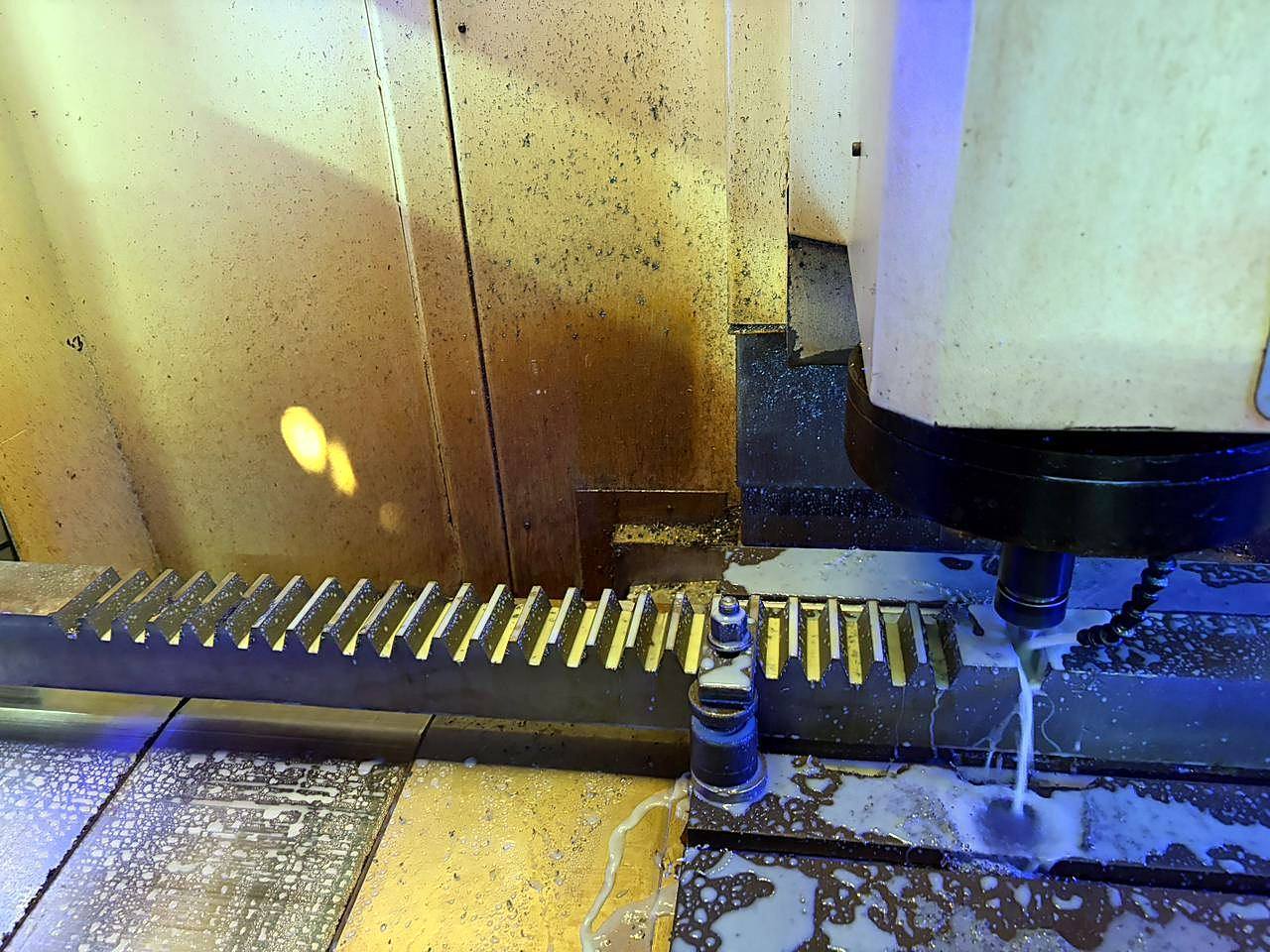
- In-House CNC Rack Cutting: Racks are cut on CNC rack-cutting machines at our unit in Gandevi, Gujarat, and pinions are hobbed in-house.
- Made to Drawing or Sample: Racks and pinions are made to your drawing or copied from a worn sample.
- Straight and Helical Teeth: Choose the tooth form to suit speed, load and noise requirements.
- Lengths to Suit Your Travel: Racks are made to the length you need, or in matched sections for long travel.
- Induction Hardening In-House: Rack and pinion teeth can be induction hardened at our unit for wear resistance.
- Material Matched to the Application: Steel grade and hardness are chosen for the load and duty.
- Inspection Before Dispatch: Pitch, tooth dimensions and straightness are checked with dial gauges before dispatch.
- One-Off to Batch, Across India and Export: From single replacements to batch orders, supplied across India and exported under our IEC registration.
This product is part of our industrial transmission gear range, made at our unit in Gujarat and supplied across India.
Related products: Gear Coupling, Industrial Gearbox, Spur Gear, Spiral Bevel Gear.
Get a Quote for Rack and Pinion
Looking for a rack and pinion manufacturer in India? Send your drawing or sample, the rack length and the quantity to Asar Engineering. We make racks and pinions in Gujarat, supply across India and take export orders.
Get an accurate quote
What to Send for Your Rack And Pinion Quote
- Drawing, sample or clear photos with main dimensions
- Module or DP, number of teeth and pressure angle
- Face width, bore size and keyway or spline details
- Material and hardness, if known
- Quantity and the date you need the parts
Have a drawing, a sample or a worn part?
Send it with the quantity. We reply with material, hardness, price and delivery time.
Industries That Use Our Racks and Pinions
Material, hardness and fit are chosen for the duty the part will see in your plant.
-
Cement
Racks and Pinions for kiln, mill, crusher and conveyor drives.
-
Steel & Metal
Racks and Pinions for rolling mills and processing lines.
-
Sugar
Racks and Pinions for cane carriers, mill drives and bagasse conveyors.
-
Mining & Material Handling
Racks and Pinions for belt conveyors, crushers and bucket elevators.
-
Chemical & Process
Racks and Pinions for pumps, mixers and agitators.
-
Machine Builders (OEM)
Racks and Pinions for new machines, made to your drawing.
Our Racks and Pinions and Recent Work
Photos of parts made and dispatched from our unit, not stock images.


Machining Videos from Our Shop Floor
Short, uncut clips of gear cutting, hobbing and machining at our unit in Gujarat.


What Our Customers Say
Reviews left on our Google Business Profile, shown word for word.
Asar Engineering supplied gearbox components for one of our industrial applications. The dimensional accuracy, finishing, and overall performance were satisfactory. We particularly appreciated their technical understanding and ability to suggest suitable solutions based on our operating requirements.
We have been sourcing industrial gearboxes from Asar Engineering Pvt. Ltd. and are satisfied with the product quality and consistency. The gearboxes are well-built, perform reliably under continuous operation, and were supplied according to our required specifications. Their team was also responsive during technical discussions and order coordination.
I bought a single screw extruder from asar engineering pvt.ltd. It's been a game changer for my manufacturing process. The extruder is efficient, easy to operate and built to last. Their customer is excellent and they guided me well through installation and setup. Highly recommended!
Rack And Pinion FAQs
Questions buyers usually ask us before sending an enquiry for rack and pinion.
Straight or helical rack and pinion - which should I choose?
A straight rack and pinion is simple, economical and suits moderate speeds. A helical set engages progressively, so it runs smoother and quieter with more teeth in contact, but it creates sideways thrust that the pinion bearings and rack mounting must take. For heavy gate or mill duty, module, material and hardening matter more than tooth form.
How far does the rack move per pinion turn, and how is backlash controlled?
One pinion revolution moves the rack by the pinion's pitch circumference: pi x module x number of teeth, using transverse module for helical teeth. Some backlash is needed for lubrication and expansion, but on CNC and automation axes too much hurts accuracy, so the rack and pinion often uses an adjustable pinion mount or a preloaded twin-pinion arrangement.
What should I specify when asking for a rack and pinion quote?
State the rack length or total travel, module, pressure angle, straight or helical teeth (with helix angle), rack section size and mounting holes, and pinion tooth count with bore or shaft details. Add the load, speed, material and hardening wanted, and the quantity. For long travel, tell us how many joined sections you need.
Can you make racks in sections for long travel, or copy a worn rack?
Yes. We cut racks on CNC rack-cutting machines to the length you need, or in sections with matched pitch at the ends so they join into one continuous rack. We also copy a worn rack and pinion from samples. Teeth can be induction hardened in-house, and pitch, tooth dimensions and straightness are checked with dial gauges.
Do you supply racks and pinions to machine builders outside Gujarat?
Yes. We supply racks and pinions across India to CNC and automation machine builders, lifting equipment makers, material handling and heavy industry, from single replacements to batch orders. We also export under our IEC registration, quoting each order against the full specification of rack length, module, tooth form, material and mounting.
How We Make Your Racks and Pinions
- Send your requirementDrawing, sample or photos of the rack and pinion, with the quantity you need.
- Technical check and quoteWe confirm material, hardness and tolerances, then send price and delivery time.
- Manufacturing and inspectionMade at our Gandevi unit; dimensions are checked before dispatch.
- DispatchPacked for road transport across India, or for export shipment.
Companies We Supply



























Need Racks and Pinions made to your drawing?
Send the drawing or a sample with the quantity. We supply across India and take export orders.