Herringbone Gear Manufacturers in India
Herringbone Gears made to your drawing or sample at our Gujarat unit, supplied across India and exported.

Asar Engineering Pvt. Ltd. Gandevi, Gujarat
- Teeth cut in-house: hobbing, shaping and spiral bevel cutting
- Induction hardening done in-house
- Made to your drawing or a worn sample
- Supplied across India and exported (IEC registered)
Herringbone and Double Helical Gears for Heavy Drives
Asar Engineering is a herringbone gear manufacturer in India, making double helical gears to drawing at its unit in Gandevi, Gujarat. A herringbone gear has two mirrored sets of helical teeth that form a V-shaped, or chevron, pattern across the face. It transmits heavy power between parallel shafts, combining the smooth engagement of helical gearing with a layout that balances the axial forces of the two opposing helices.
A single helical gear pushes its shaft sideways as it runs. A herringbone gear places a left-hand and a right-hand helix side by side, so the two axial forces cancel. This makes herringbone and double helical gearing valuable in heavy machinery with large torque, high loads and continuous duty.
We make these gears for heavy-duty drives where tooth geometry, dimensional accuracy, material and heat treatment decide how long the gearbox lasts. Teeth are cut in-house, and gears can be supplied as one-off replacements or in batches.
Herringbone and double helical gears are found in large industrial gearboxes, steel rolling mills, sugar and cement plants, mining machinery and other heavy equipment, where their higher manufacturing cost is justified by the duty.
What is a Herringbone Gear?
A herringbone gear is a double-helical gear in which two opposing helical tooth sections meet directly at the center of the gear face, forming a continuous V-shaped tooth arrangement.
The two helices are mirror images. As the gear turns, each half produces an axial force in the opposite direction to the other. With both halves sharing load equally, the net axial thrust is zero or close to zero.
To make the two halves share load equally, one of the gears in a mating pair (usually the pinion) is normally allowed to float axially so it can center itself. If both shafts are fixed axially, small errors in the apex position push more load onto one half.
This is the main advantage of herringbone gearing over single helical gears.
Double Helical Tooth Geometry
The tooth profile consists of two helical sections arranged in opposite directions. Instead of a single continuous helix, the gear contains a left-hand and right-hand section that work together as one transmission surface.
The combined geometry creates the characteristic chevron or V-shaped appearance associated with herringbone gears.
Axial Thrust Cancellation
A single helical gear produces axial thrust because its teeth are inclined to the gear axis. A herringbone gear counters this by placing an opposing helix directly beside the first.
The axial force generated by one tooth section acts in the opposite direction to the force generated by the other section. This substantially reduces the net side thrust transmitted to the shaft and bearings.
Continuous Tooth Engagement
Like other helical gears, herringbone gears provide progressive tooth engagement rather than the sudden engagement associated with straight-cut spur gears.
The gradual contact between teeth can contribute to smoother transmission, reduced vibration, and quieter operation, particularly in high-speed industrial machinery.
High Load-Carrying Capability
The double helical arrangement allows a wide face and a higher helix angle without adding axial thrust, which gives a large effective contact area. This suits drives that must transmit heavy torque continuously.
Parallel Shaft Transmission
Herringbone gears are primarily used to transmit power between parallel shafts. The gear pair can provide controlled changes in speed and torque while maintaining smooth tooth engagement.
The exact gear ratio depends on the tooth counts of the driving and driven gears.
Manufacturing Complexity
One of the most important characteristics of a true herringbone gear is the direct meeting of the two helical tooth sections at the center.
Cutting this uninterrupted V-shaped junction needs special gear-shaping machines and careful control of tooth geometry, which makes true herringbone gears more difficult and costly to produce than most gear types. For this reason, many industrial gears described as herringbone are actually double helical gears with a narrow central groove, which can be hobbed.
Applications of Herringbone Gear
Herringbone gears are used for heavy-duty power transmission where high torque, large loads, smooth running and controlled axial forces all matter.
Their higher cost makes them unsuitable for ordinary light machinery. They are used in large, critical drives where load capacity and reliability justify the extra manufacturing effort.
Mining Machinery
Mining equipment needs gears that carry heavy torque in dusty, shock-loaded conditions. Double helical gears are used in gearboxes for crushers, grinding mills and other mineral-processing equipment.
Heavy Pump Drives
Large reciprocating pumps, such as oil-field mud pumps, have long used herringbone and double helical gearing to carry heavy, continuous loads. The same principle applies to other heavy-duty pump drives in process plants.
Sugar Mill Drives
Sugar mill crushing rolls run under very high torque at low speed. Double helical gears are used in mill drive gearboxes and roll pinions because they carry heavy load without pushing the shafts sideways.
Steel Rolling Mills
Rolling mills need large drives that run under heavy, fluctuating loads. Herringbone pinion stands and double helical gearboxes suit this duty because of their high torque capacity and balanced axial forces.
Rubber Processing Mills
Rubber mixing mills and calenders need high torque for continuous processing. Double helical gears are used in the large gearboxes that drive them.
Cement Plant Drives
Ball mills, vertical roller mills and kiln drives in cement plants use heavy gearboxes where double helical gears help control shaft thrust under continuous load.
Power Plant and Turbine Gearboxes
Double helical gears are widely used in turbine reduction gearboxes and heavy fan and mill drives in power plants. High-speed turbine sets need ground teeth and are usually built by specialist gearbox makers; replacement gears for slower auxiliary drives can be made to drawing.
Heavy Industrial Gearboxes
Herringbone gears form part of large industrial gearboxes for high-power machinery, where controlling shaft thrust is an important design point.
Common Types of Herringbone Gears
Herringbone gears are grouped by tooth construction, duty and configuration. The key distinction is between true herringbone gears, where the two helices meet directly, and double helical gears, where a central groove separates them.
True Herringbone Gear
A true herringbone gear has opposing helical teeth that meet directly at the center of the gear face, producing an uninterrupted V-shaped or chevron profile.
This removes the dead space of a central groove and gives a compact tooth layout. However, the center junction makes manufacturing much more demanding, as the teeth must be cut on special gear-shaping machines.
Double Helical Gear with Central Groove
A standard double-helical gear uses two opposing helical tooth sections separated by a central relief groove.
The groove gives clearance for the hob to run out, so each helix can be cut by standard hobbing. This makes production simpler than a true herringbone gear. The two designs are closely related but not identical, and the drawing should state which one is required.
Heavy-Duty Herringbone Gear
Heavy-duty herringbone gears are manufactured for applications involving high torque, large loads, and continuous industrial operation.
They are used in large gearboxes, steel mills, sugar and cement plants, mining equipment and other heavy power-transmission machinery.
High-Speed Herringbone Gear
High-speed herringbone gears are designed around applications where smooth engagement, vibration control, and stable operation at elevated rotational speeds are important.
The progressive engagement of the helical teeth can help produce smooth power transmission when the gear is correctly designed and balanced for its operating conditions.
Custom Herringbone Gear
Custom herringbone gears are made to suit a specific machine. Key parameters include module, number of teeth, face width, helix angle, groove width, bore size, ratio, material, heat treatment and operating load.
Custom manufacture is common for large industrial equipment where standard gear sizes do not match the existing gearbox.
Core Components
A herringbone gear assembly has several features that together decide its load capacity and life.
Chevron Tooth Profile
The defining component of the gear is its V-shaped tooth profile. The opposing helical sections meet at the center and provide the characteristic herringbone geometry.
Left-Hand Helix
One half of the gear uses a left-hand helical tooth direction. This section generates axial force during operation.
Right-Hand Helix
The opposite half uses a right-hand helix. Its axial force acts in the opposite direction to the left-hand section, balancing the overall thrust.
Gear Face
The gear face contains the complete double-helical tooth arrangement. Its width determines the available tooth-contact area and contributes to the overall load capacity.
Gear Bore
The central bore allows the gear to be mounted securely onto the transmission shaft. Bore dimensions must correspond accurately to the shaft and mounting arrangement.
Hub
Depending on the design, a hub may surround the bore to provide additional structural support and secure shaft mounting.
Central Tooth Junction
In a true herringbone gear, the opposing helical tooth sections meet directly at the center. This junction must be manufactured with high precision to maintain the intended tooth geometry.
Shaft and Bearing Arrangement
Although the herringbone pattern balances axial forces, the drive still needs properly designed shafts and bearings to carry radial loads and torque, and one shaft is usually left free to float axially so both halves share load.
Herringbone Gear Supplier in India
Choosing a herringbone gear supplier in India means looking at the whole drive, not just a diameter or tooth count.
These gears run in demanding machinery, where tooth geometry, material strength, heat treatment and dimensional accuracy decide how well the gearbox performs.
Asar Engineering supplies herringbone and double helical gears for heavy-duty drives. We work from your drawing or sample and check the ratio, module, number of teeth, face width, helix angle, shaft diameter, torque, speed, material grade, heat treatment and operating environment.
The two opposing helices must line up accurately at the center, so the apex sits where the drawing places it. Poor alignment of the halves leads to uneven load sharing and early wear.
Before dispatch, bore, runout, face width and other critical dimensions are checked with dial gauges against the drawing.
Where spur or single helical gears cannot give the load capacity and axial-force control you need, a double helical gear made to your requirement is often the answer.
Benefits of Herringbone Gears
Zero or Reduced Net Axial Thrust
The opposing helices generate axial forces in opposite directions, substantially balancing the thrust produced by the gear.
High Load Capacity
The wide double-helical tooth arrangement provides substantial contact area, making herringbone gears suitable for demanding high-torque transmission applications.
Smooth Power Transmission
Progressive helical tooth engagement helps produce smoother transmission than conventional straight-tooth gearing.
High-Speed Operation
Helical engagement supports smooth running at higher speeds, when the gears are correctly designed, finished and balanced.
Reduced Vibration
The continuous engagement of the angled teeth can help minimize sudden tooth impacts and contribute to stable transmission operation.
Heavy-Duty Performance
Herringbone gears suit large industrial drives exposed to heavy loads and continuous operation.
Compact High-Power Transmission
The absence of a central relief groove in true herringbone construction can provide an efficient tooth footprint for high-load transmission within the available face width.
Reduced Dependence on Thrust Bearings
Because the opposing helices balance axial forces, the transmission may require less dedicated thrust-bearing capacity than an equivalent single-helical arrangement, depending on the complete system design.
Herringbone Gear Specifications
| Specification | Typical Range / Consideration |
|---|---|
| Gear Type | Herringbone / Chevron Gear |
| Gear Construction | Double helical |
| Tooth Arrangement | Mirrored left-hand and right-hand helices |
| Tooth Junction | Direct center meeting in true herringbone design |
| Shaft Arrangement | Parallel shafts |
| Axial Thrust | Opposing helical forces substantially cancel when both halves share load (one shaft usually floats axially) |
| Load Capacity | High, application-dependent |
| Operating Speed | Suitable for high speeds when properly designed, finished and balanced |
| Gear Ratio | Determined by driving and driven tooth counts |
| Materials | Alloy and carbon steels selected for the application |
| Heat Treatment | As required, e.g. through-hardening or induction hardening |
| Bore | Customized according to shaft requirements |
| Face Width | Selected according to load and transmission requirements |
| Applications | Steel rolling mills, sugar and cement mills, mining, rubber mills, heavy pumps and industrial gearboxes |
| Manufacturing | Double helical with central groove: hobbing. True herringbone (no groove): special gear shaping |
Herringbone Gear Exporter from India
Asar Engineering is IEC registered and takes export orders for herringbone and double helical gears made to the customer's drawing.
Export orders are quoted against the full specification: tooth dimensions, ratio, face width, groove width, bore, material, heat treatment and inspection requirements.
These gears usually go into large, critical machinery, so the part must match the drawing. The chevron profile, apex position, concentricity and tolerances are checked so the gear fits the customer's gearbox.
Why Choose Asar Engineering
- In-House Teeth Cutting: Helical teeth are cut at our own unit in Gandevi, Gujarat, including heavy-module work.
- Made to Drawing or Sample: Gears are made to your drawing or from a worn sample, matched to your torque, speed and gearbox.
- Accurate Helix Alignment: The two opposing helices are set out so the apex sits where the drawing places it.
- Induction Hardening In-House: Teeth can be induction hardened at our unit for wear resistance.
- Material Matched to the Application: Steel grade and hardness are chosen for the load, speed and service conditions.
- Inspection Before Dispatch: Bore, runout and key dimensions are checked with dial gauges before dispatch.
- One-Off to Batch Quantities: From a single replacement gear to batch orders.
- Supply Across India and Export: We supply customers across India and take export orders under our IEC registration.
This product is part of our industrial transmission gear range, made at our unit in Gujarat and supplied across India.
Related products: Gear Coupling, Spiral Bevel Gear, Worm Gear.
Get a Quote for Herringbone Gears
Looking for a herringbone gear manufacturer in India for a heavy-duty drive? Send your drawing or sample and the quantity to Asar Engineering, and state whether you need a true herringbone or a double helical gear with a groove. We make gears in Gujarat, supply across India and take export orders.
Get an accurate quote
What to Send for Your Herringbone Gear Quote
- Drawing, sample or clear photos with main dimensions
- Module or DP, number of teeth and pressure angle
- Face width, bore size and keyway or spline details
- Material and hardness, if known
- Quantity and the date you need the parts
Have a drawing, a sample or a worn part?
Send it with the quantity. We reply with material, hardness, price and delivery time.
Industries That Use Our Herringbone Gears
Material, hardness and fit are chosen for the duty the part will see in your plant.
-
Cement
Herringbone Gears for kiln, mill, crusher and conveyor drives.
-
Steel & Metal
Herringbone Gears for rolling mills and processing lines.
-
Sugar
Herringbone Gears for cane carriers, mill drives and bagasse conveyors.
-
Mining & Material Handling
Herringbone Gears for belt conveyors, crushers and bucket elevators.
-
Chemical & Process
Herringbone Gears for pumps, mixers and agitators.
-
Machine Builders (OEM)
Herringbone Gears for new machines, made to your drawing.
Our Herringbone Gears and Recent Work
Photos of parts made and dispatched from our unit, not stock images.

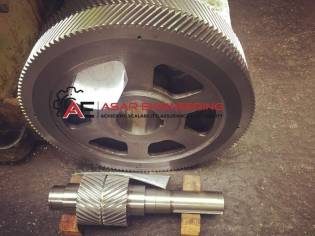


Machining Videos from Our Shop Floor
Short, uncut clips of gear cutting, hobbing and machining at our unit in Gujarat.


What Our Customers Say
Reviews left on our Google Business Profile, shown word for word.
Asar Engineering supplied gearbox components for one of our industrial applications. The dimensional accuracy, finishing, and overall performance were satisfactory. We particularly appreciated their technical understanding and ability to suggest suitable solutions based on our operating requirements.
We have been sourcing industrial gearboxes from Asar Engineering Pvt. Ltd. and are satisfied with the product quality and consistency. The gearboxes are well-built, perform reliably under continuous operation, and were supplied according to our required specifications. Their team was also responsive during technical discussions and order coordination.
I bought a single screw extruder from asar engineering pvt.ltd. It's been a game changer for my manufacturing process. The extruder is efficient, easy to operate and built to last. Their customer is excellent and they guided me well through installation and setup. Highly recommended!
Herringbone Gear FAQs
Questions buyers usually ask us before sending an enquiry for herringbone gear.
Do I need a true herringbone gear or a double helical gear with a groove?
Check the drawing or the old part. In a true herringbone gear the two helices meet at the centre with no gap, and the teeth must be cut on special gear-shaping machines. A double helical gear has a central groove for the hob to run out, so it is simpler to make. Please state which one you need when you enquire.
Why does a herringbone gear drive need one shaft free to float axially?
The opposing helices cancel axial thrust only when both halves carry equal load. If both shafts are held axially, small errors in apex position push more load onto one half and cause uneven wear. Usually the pinion is left free to float so it centres itself. For the same reason, we set out the apex of each herringbone gear exactly where the drawing places it.
What details should a herringbone gear enquiry include?
Send the drawing or sample, with module, tooth counts, face width, groove width if any, helix angle, and bore and hub dimensions. Include the torque, speed, gearbox or machine type, required steel grade and heat treatment, and the quantity. Say clearly whether the gear is true herringbone or grooved double helical.
Can you make a replacement double helical gear for a sugar mill or rolling mill gearbox?
Yes. We make herringbone and double helical gears to drawing or from a worn sample, matched to your torque, speed and existing gearbox. Teeth are cut in-house, including heavy-module work, and can be induction hardened at our unit. Bore, runout, face width and other critical dimensions are checked with dial gauges before dispatch.
Do you supply single replacement herringbone gears, and do you export?
Yes. A single replacement herringbone gear is as welcome as a batch order. We manufacture at Gandevi, Gujarat, supply plants across India and take export orders under our IEC registration. Export enquiries are quoted against the full specification, including tooth dimensions, groove width, bore, material, heat treatment and inspection needs.
How We Make Your Herringbone Gears
- Send your requirementDrawing, sample or photos of the herringbone gear, with the quantity you need.
- Technical check and quoteWe confirm material, hardness and tolerances, then send price and delivery time.
- Manufacturing and inspectionMade at our Gandevi unit; dimensions are checked before dispatch.
- DispatchPacked for road transport across India, or for export shipment.
Companies We Supply






















Need Herringbone Gears made to your drawing?
Send the drawing or a sample with the quantity. We supply across India and take export orders.