Helical Gear Manufacturers in India
Helical Gears made to your drawing or sample at our Gujarat unit, supplied across India and exported.

Asar Engineering Pvt. Ltd. Gandevi, Gujarat
- Teeth cut in-house: hobbing, shaping and spiral bevel cutting
- Induction hardening done in-house
- Made to your drawing or a worn sample
- Supplied across India and exported (IEC registered)
Helical Gears for Smooth, Quiet Power Transmission
Asar Engineering is a helical gear manufacturer in India, with its manufacturing unit at Gandevi, Gujarat. We hob and shape helical gears in-house to the customer's drawing or sample. A helical gear is a cylindrical gear whose teeth are cut at an angle, the helix angle, to the axis of rotation. Unlike spur gear teeth, which run parallel to the axis, helical teeth engage progressively as the gears turn. This reduces impact, vibration and noise and gives smooth, efficient power transmission.
Helical gears are mainly used between parallel shafts. A special arrangement, crossed helical gears, can also connect non-parallel, non-intersecting shafts, but only for light loads. On parallel shafts, the inclined teeth give a longer total line of contact, so a helical gear carries more load than a spur gear of the same size and still runs smoothly.
Each helical gear is designed around the machine's power, torque, speed, ratio, shaft arrangement, helix angle, operating temperature, lubrication and duty cycle.
When choosing a helical gear manufacturer in India, check tooth accuracy, material and heat treatment, inspection methods, and whether the supplier can make gears to your drawing or from a sample. Helical gears are used in industrial gearboxes, conveyors, elevators, steel plants, power plants, material handling systems and other machinery that runs continuously.
What is a Helical Gear?
A helical gear is a cylindrical gear with teeth inclined to its axis. This is what distinguishes it from a spur gear, whose straight teeth are parallel to the axis of rotation.
Two external helical gears running on parallel shafts must have the same helix angle and opposite hands: a right-hand gear meshes with a left-hand gear. This lets the inclined teeth mesh correctly and transmit power from the input shaft to the output shaft.
The key feature of a helical gear is progressive engagement. The teeth do not come into contact across the full face width at once. Contact starts at one end of the tooth and moves diagonally across the face as the gears turn. This reduces sudden impact and makes running smoother.
The main design parameters of a helical gear pair are:
- Helix Angle: The angle at which the teeth are inclined to the gear axis.
- Pressure Angle: The angle that sets the direction of force between mating teeth.
- Gear Ratio: The number of teeth on the driven gear divided by the number on the driving gear.
- Module: The basic tooth-size parameter. For helical gears it is stated as normal module (measured perpendicular to the teeth) or transverse module.
- Pitch Diameter: The reference diameter on which the meshing of the pair is based.
- Face Width: The width of the teeth available to carry the load.
- Material: Selected according to load, speed, wear, fatigue and operating conditions.
- Heat Treatment: Hardening that improves hardness, strength, wear resistance and fatigue life.
- Lubrication: Reduces friction, controls heat and protects the tooth surfaces.
- Operating Speed: The speed at which the gear pair is designed to run.
- Transmitted Torque: The torque the gear must carry safely.
- Shaft Arrangement: Parallel shafts in most cases; crossed helical gears for skew shafts.
In heavy-duty drives, correct design is important because helical gears produce axial thrust as well as tangential and radial forces. The thrust increases with helix angle and must be taken by suitable bearings and a rigid housing.
The direction of the thrust depends on the hand of the helix and the direction of rotation, so it can reverse when the drive reverses. Bearings must be able to take thrust in both directions where that happens.
Applications of Helical Gears
Helical gears are used in industrial machinery that needs smooth, quiet, continuous power transmission. Because the load is shared across more than one tooth, they suit both high-speed and heavy-duty drives.
Common applications include:
- Industrial Gearboxes: Helical gears are the most common gears in industrial gearboxes that reduce speed and increase torque for driven machinery.
- Conveyor Systems: Conveyor and material-handling drives use helical gearboxes for controlled speed and continuous running.
- Steel Plants: Rolling mill auxiliaries, roller tables and processing machinery use helical gears for high loads and continuous duty.
- Elevators and Hoists: Lift and hoist drives use helical gears to convert motor speed into lifting torque.
- Power Plants: Coal and ash handling, pumps, compressors and auxiliary drives use helical gears.
- Mining Machinery: Conveyors, crushers, feeders and processing equipment use helical gear drives for high torque.
- Cement Plants: Conveyors, mills, crushers, mixers and other rotating machinery use helical gear drives.
- Material Handling: Cranes, hoists, conveyors and lifting equipment use helical gear drives.
- Packaging Machinery: Packaging lines use helical gears for smooth motion and low vibration.
- Food Processing Machinery: Mixers, conveyors and processing machines use enclosed, lubricated helical gear drives.
- Paper and Sugar Industry: Rollers, dryers, conveyors, cutters and cane-handling equipment use helical gear drives.
- Chemical and Plastics Processing: Pumps, mixers, agitators, extruders and conveyors use helical gear drives.
- General Manufacturing: Production lines, machine tools and special-purpose machines use helical gears to suit their speed, torque and shaft layout.
The right helical gear depends on speed, torque, power, duty cycle, ratio, shaft arrangement, lubrication, environment and expected service life.
Common Types of Helical Gears
Helical gears are made in different forms depending on shaft arrangement, axial thrust, load and operating environment.
Single Helical Gears
Single helical gears have one set of inclined teeth across the face width. They are the most widely used type and give smooth, gradual engagement.
Because the teeth are inclined, single helical gears produce axial thrust. Bearings and housing must be selected to take this force safely.
Double Helical Gears
Double helical gears have two sets of helical teeth of opposite hand, usually separated by a central groove for the hobbing tool to run out. The axial forces of the two halves act in opposite directions and cancel each other.
This makes them useful in heavy-duty drives that need high torque and smooth running with little net axial load on the bearings.
Herringbone Gears
Herringbone gears are a form of double helical gear in which the two sets of teeth meet at the centre without a gap, forming a V pattern.
Because there is no central groove, the full face width carries load, but the teeth cannot be cut by normal hobbing and need special shaping machines. They are used where high load capacity and smooth running are needed in a narrow width.
Crossed Helical Gears
Crossed helical gears, also called screw gears, connect shafts that are neither parallel nor intersecting. Both gears are usually of the same hand when the shafts are at 90 degrees.
The teeth make point contact with a lot of sliding, so friction losses are higher and load capacity is much lower than with parallel-shaft helical gears. They are used for light loads and special drives.
Parallel-Shaft Helical Gears
Parallel-shaft helical gears are the standard arrangement, with two mating gears on parallel shafts. The gears have equal helix angles and opposite hands so that the teeth mesh correctly.
This arrangement is widely used in industrial gearboxes, conveyors, machine drives and manufacturing equipment.
Core Components of a Helical Gear Drive
A helical gear drive consists of several components that work together to transmit power, torque and rotation.
Gear Teeth
The inclined teeth carry the load. Helix angle, pressure angle, module, face width, tooth profile and accuracy decide how the gear pair performs.
Helix Angle
The helix angle is the inclination of the teeth to the axis of rotation. It affects tooth engagement, load sharing, axial thrust and running behaviour: a larger angle gives smoother running but more thrust.
Gear Body
The gear body supports the teeth and connects them to the shaft through the bore, keyway or spline. It must be strong enough for the transmitted torque and operating loads.
Shaft
The shaft carries the gear and transmits rotation to the connected machinery. It must be designed for torsional, bending and other stresses.
Bearings
Bearings support the shafts and hold them in position. Because single helical gears produce axial thrust, the bearing arrangement must include thrust-carrying bearings, such as taper roller or angular contact bearings.
Gear Housing
The housing encloses the gear assembly and supports the gears, shafts, bearings, seals and lubrication system. It also keeps out contamination.
Lubrication System
Lubrication reduces friction between mating teeth, limits wear, removes heat and protects the tooth surfaces. Depending on the design, it may be splash, oil bath or forced circulation.
Seals
Seals keep the lubricant in and keep dust, moisture and other contaminants out. Good sealing is especially important in dusty industrial plants.
Couplings
Couplings connect the gearbox to motors, driven machinery or other shafts. Depending on the design, they can take up limited misalignment.
Thrust-Support Arrangement
The axial force from single helical gears needs a suitable bearing and housing arrangement. Correct thrust management keeps the gears aligned and prevents overloading of the drive components.
Helical Gear Supplier in India
As a helical gear supplier in India, we know that a gear cannot be selected on nominal motor power alone. Operating speed, torque, duty cycle, shock loads, ratio, environment, lubrication, shaft arrangement and running hours all affect the choice.
Asar Engineering supplies helical gears as new parts, as replacements for existing gearboxes and machines, and to customer drawings, with material and hardening chosen for the application.
When evaluating a helical gear supplier, consider:
- Manufacturing and engineering capabilities
- Gear tooth machining accuracy
- Helix-angle accuracy
- Material selection
- Heat-treatment practices
- Surface finish
- Dimensional inspection
- Gear ratio requirements
- Load and torque capacity
- Operating speed
- Bearing arrangements
- Lubrication requirements
- Customization capabilities
- Quality inspection procedures
- Technical support
- Delivery coordination
A good supplier also understands axial thrust in single helical drives. Bearing selection, shaft design, housing, lubrication and alignment all affect the reliability of the complete drive.
If you are replacing a worn helical gear and have no drawing, send the gear or, better, the pair. We measure the tooth count, normal module, helix angle and hand, pressure angle and bore details from the sample, and check whether the mating gear also needs replacing. Tell us the machine, motor power and speed so that material and hardening can be checked.
Benefits of Helical Gears
- Smooth Tooth Engagement: The inclined teeth enter the mesh progressively, reducing impact and giving smoother power transmission.
- Quiet Operation: Progressive contact reduces vibration and noise compared with spur gears, which suits high-speed drives.
- Higher Load Capacity: More than one pair of teeth shares the load at a time, so helical gears carry more load than spur gears of the same size.
- High-Speed Operation: Smooth engagement makes helical gears suitable for machinery running at higher speeds.
- Efficient Power Transmission: Well-made and lubricated helical gears transmit power between parallel shafts with low losses, typically around 98% per stage.
- Reduced Shock Loading: The gradual movement of tooth contact reduces sudden loading during engagement.
- High Torque Capability: Helical gears can be designed to carry high torque in heavy-duty industrial machinery.
- Application Flexibility: Helical gears are used in industrial gearboxes, conveyors, elevators, power plant equipment, manufacturing machinery and many other systems.
- Suitable for Compact Gearboxes: Multi-stage helical arrangements give large speed reduction and torque increase in an enclosed gearbox.
- Long Service Life: The right material, heat treatment, lubrication, alignment and maintenance give long operating life.
- Thrust Balancing: Double helical and herringbone gears cancel the axial forces, which is useful in heavy-duty drives.
Helical Gear Specifications
| Technical Parameter | Typical Range | Description |
|---|---|---|
| Gear Type | Single helical, double helical, herringbone, crossed helical | Configuration selected according to application |
| Shaft Arrangement | Mainly parallel; crossed (skew) for crossed helical gears | Depends on gear configuration |
| Tooth Design | Angled / Helical | Teeth are inclined relative to the gear axis |
| Helix Angle | Commonly 8°–30° (single helical); 25°–40° (double helical) | Sets tooth inclination; a larger angle gives smoother running but more axial thrust |
| Pressure Angle | Commonly 20° (normal) | Influences tooth-force direction and gear meshing |
| Gear Ratio | Application dependent | Determined by the tooth-count relationship |
| Module | Application dependent | Defines fundamental tooth dimensions |
| Face Width | Application dependent | Tooth width available for load transmission |
| Material | Carbon or alloy steel, e.g. EN8, EN9, EN19, EN24, 20MnCr5 | Selected according to load, wear, and operating conditions |
| Heat Treatment | Induction hardening, through hardening; case carburising where specified | May improve hardness, strength, and wear resistance |
| Operating Speed | Application dependent | Selected according to gear design and lubrication |
| Torque Capacity | Application dependent | Determined through engineering calculations |
| Lubrication | Oil / Oil Bath / Forced Circulation | Selected according to speed, load, and gearbox design |
| Bearing Arrangement | Radial plus thrust-carrying bearings (e.g. taper roller) | Selected according to generated gear forces |
| Manufacturing Accuracy | Application dependent | Influences noise, vibration, contact, and service performance |
| Mounting Arrangement | Application dependent | Must maintain correct shaft and gear alignment |
Actual limits, dimensions, ratio, helix angle, material, torque capacity, speed, lubrication and tolerances must be confirmed for each helical gear design by calculation.
Helical Gear Exporter from India
Asar Engineering is a helical gear exporter from India and is registered with an IEC (Importer-Exporter Code). We take export orders for helical gears used in industrial gearboxes, conveyors, elevators, steel, cement, mining, power and material handling machinery.
Beyond dimensions and tooth geometry, export orders need attention to material specifications, inspection, packaging, documentation and delivery planning.
Helical gears for export can be made to your requirements for:
- Gear diameter
- Number of teeth
- Module
- Helix angle
- Pressure angle
- Face width
- Gear ratio
- Shaft arrangement
- Input speed
- Output speed
- Transmitted torque
- Material
- Heat treatment
- Lubrication
- Mounting configuration
Complete machine and operating details help us check the gear design and make a gear that suits the application.
Why Choose Asar Engineering
- In-House Teeth Cutting: Helical teeth are hobbed and shaped in-house at our unit in Gandevi, Gujarat.
- Made to Drawing or Sample: We manufacture to your drawing or from a worn sample, from one-off replacements to batch orders.
- Induction Hardening In-House: Teeth can be induction hardened in our own facility for wear resistance.
- Material Matched to the Application: Material and hardness are selected according to load, speed, duty cycle and operating conditions.
- Inspection Before Dispatch: Dimensions and runout are checked with dial gauges before every gear is dispatched.
- Technical Support: You can discuss power, torque, speed, ratio, shaft arrangement and lubrication with our team before ordering.
- Supply Across India and Export: We supply customers across India and take export orders as an IEC-registered company.
This product is part of our industrial transmission gear range, made at our unit in Gujarat and supplied across India.
Related products: Gear Coupling, Spiral Bevel Gear, Worm Gear.
Get Helical Gears Made to Your Drawing
Send us your drawing or sample, the quantity you need and details of your application, and we will quote. Asar Engineering supplies helical gears across India and takes export orders.
Get an accurate quote
What to Send for Your Helical Gear Quote
- Drawing, sample or clear photos with main dimensions
- Module or DP, number of teeth and pressure angle
- Face width, bore size and keyway or spline details
- Material and hardness, if known
- Quantity and the date you need the parts
Have a drawing, a sample or a worn part?
Send it with the quantity. We reply with material, hardness, price and delivery time.
Industries That Use Our Helical Gears
Material, hardness and fit are chosen for the duty the part will see in your plant.
-
Cement
Helical Gears for kiln, mill, crusher and conveyor drives.
-
Steel & Metal
Helical Gears for rolling mills and processing lines.
-
Sugar
Helical Gears for cane carriers, mill drives and bagasse conveyors.
-
Mining & Material Handling
Helical Gears for belt conveyors, crushers and bucket elevators.
-
Chemical & Process
Helical Gears for pumps, mixers and agitators.
-
Machine Builders (OEM)
Helical Gears for new machines, made to your drawing.
Our Helical Gears and Recent Work
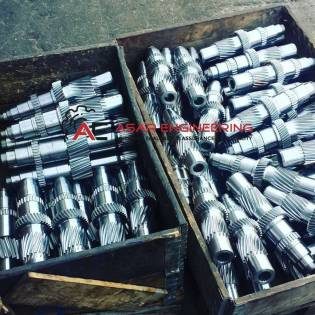
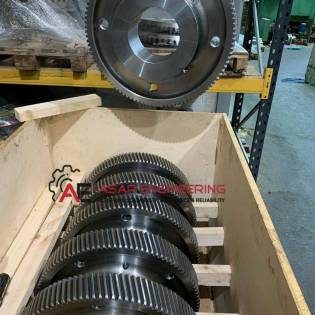
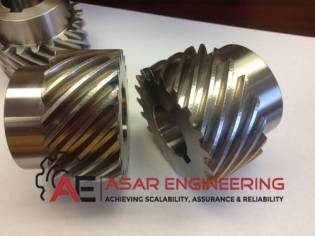
Photos of parts made and dispatched from our unit, not stock images.



Machining Videos from Our Shop Floor
Short, uncut clips of gear cutting, hobbing and machining at our unit in Gujarat.


What Our Customers Say
Reviews left on our Google Business Profile, shown word for word.
Asar Engineering supplied gearbox components for one of our industrial applications. The dimensional accuracy, finishing, and overall performance were satisfactory. We particularly appreciated their technical understanding and ability to suggest suitable solutions based on our operating requirements.
We have been sourcing industrial gearboxes from Asar Engineering Pvt. Ltd. and are satisfied with the product quality and consistency. The gearboxes are well-built, perform reliably under continuous operation, and were supplied according to our required specifications. Their team was also responsive during technical discussions and order coordination.
I bought a single screw extruder from asar engineering pvt.ltd. It's been a game changer for my manufacturing process. The extruder is efficient, easy to operate and built to last. Their customer is excellent and they guided me well through installation and setup. Highly recommended!
Helical Gear FAQs
Questions buyers usually ask us before sending an enquiry for helical gear.
Single helical, double helical or crossed helical - which do I need?
For most parallel-shaft gearboxes a single helical gear is the standard choice, as long as the bearings can take its axial thrust. Double helical gears cancel that thrust and suit heavy drives. Crossed helical (screw) gears connect skew shafts but carry only light loads. We make these types to drawing and can advise on the right one.
What helix angle is normal for a helical gear, and how does it affect the bearings?
Single helical gears commonly use about 8 to 30 degrees, and double helical gears about 25 to 40 degrees. A larger angle runs smoother but creates more axial thrust, and that thrust changes direction when the drive reverses. The bearing arrangement should therefore include thrust-carrying bearings, such as taper roller or angular contact types.
What details do you need to quote a helical gear?
Send the drawing or the old gear, with tooth count, normal module, helix angle and hand, pressure angle, face width, bore and keyway. Tell us about the mating gear, centre distance, material and hardness if known, plus motor power, speed and quantity. Helix hand is easy to miss, so please confirm it clearly.
Can you make a replacement helical gear from a worn sample with no drawing?
Yes. Send the worn gear, or preferably both gears of the pair. We measure tooth count, normal module, helix angle and hand, pressure angle and bore from the sample, then hob or shape the new helical gear in-house. We also check whether the mating gear is worn enough that it should be replaced at the same time.
Do you take small orders for helical gears, and do you export?
Yes to both. We make helical gears from single replacement pieces to batch orders at our unit in Gandevi, Gujarat, and supply them across India. As an IEC-registered company we also export gears made to the customer's drawing, with dimensions and runout checked on dial gauges before dispatch.
How We Make Your Helical Gears
- Send your requirementDrawing, sample or photos of the helical gear, with the quantity you need.
- Technical check and quoteWe confirm material, hardness and tolerances, then send price and delivery time.
- Manufacturing and inspectionMade at our Gandevi unit; dimensions are checked before dispatch.
- DispatchPacked for road transport across India, or for export shipment.
Companies We Supply



























Need Helical Gears made to your drawing?
Send the drawing or a sample with the quantity. We supply across India and take export orders.