Industrial Chain Sprocket Manufacturers in India
Simplex, duplex, triplex and conveyor sprockets, bored and keyed to your shaft. Teeth can be induction hardened for longer life in heavy or dusty chain drives.

Asar Engineering Pvt. Ltd. Gandevi, Gujarat
- Teeth cut to ISO / BS and ANSI chain sizes
- Teeth induction hardened on request
- Bored and keyed to your shaft size
- Supplied across India and exported (IEC registered)
Types of Industrial Chain Sprockets We Make


Chain Sprockets Bored and Keyed to Your Shaft
An industrial chain sprocket is a toothed wheel whose teeth engage directly with a roller chain, conveyor chain or other matching chain. Unlike gears, which transmit motion through direct tooth-to-tooth contact, sprockets transmit power through a chain running between them. This makes them suitable for power transmission, speed reduction, timed motion and moving material along conveyors.
Asar Engineering is an industrial chain sprocket manufacturer in India, making sprockets to drawing or sample at our unit in Gandevi, Gujarat. Sprockets can be made to suit chain size, number of strands, hub type, bore, material and tooth profile. These choices directly affect chain engagement, load distribution, chain and sprocket life, and maintenance.
Industrial chain sprockets are used in conveyors, bucket elevators, packaging machines, material-handling equipment, agricultural machinery, sugar and cement plant equipment, and other industrial drives. Depending on the application, they are made as flat plate, single hub, double hub or offset hub designs, for simplex, duplex or triplex chain.
What is an Industrial Chain Sprocket?
An industrial chain sprocket is a toothed wheel that engages positively with a chain to transfer power between two rotating shafts. As the sprocket turns, its teeth catch the chain rollers and pull the chain around. The chain then drives another sprocket, a conveyor or another mechanism.
The main difference between a sprocket and a gear is how power is transmitted. Gears mesh directly with each other; sprockets use a flexible chain between the driving and driven parts. This allows power to be transmitted over a longer centre distance with positive engagement and no slip, unlike belt drives.
Important technical factors when selecting industrial chain sprockets:
- Tooth profile: The tooth geometry must correspond correctly with the pitch and dimensions of the selected chain.
- Pitch: Sprocket pitch must match the chain pitch to maintain proper engagement and minimize impact loading.
- Number of teeth: Tooth count influences speed ratio, chain articulation, wrap, and overall transmission characteristics.
- Hub construction: Hub configuration determines how the sprocket is mounted and supported on the shaft.
- Bore arrangement: Pilot (plain) bore, finished bore with keyway, taper-lock and QD bushing arrangements can be chosen to suit installation.
- Chain strands: Simplex, duplex, and triplex sprockets accommodate different load requirements through single or multiple chain rows.
- Material: Carbon steel, cast iron, stainless steel and engineering plastics such as nylon can be selected according to load, environment, corrosion and noise.
- Hardening: Steel sprocket teeth can be induction hardened to resist wear while keeping a tough core.
- Shaft arrangement: Proper sprocket positioning and shaft alignment are essential for smooth chain movement and balanced loading.
- Operating environment: Moisture, chemicals, temperature, contamination, washdown conditions, and cleanliness requirements can influence material selection.
- Load characteristics: Continuous loads, shock loads, starting loads, and variable loads should be considered when selecting sprocket and chain combinations.
- Maintenance requirements: The sprocket should be selected and installed so that inspection, lubrication, replacement, and alignment checks can be performed efficiently.
Hub Classifications of Industrial Chain Sprockets
Sprockets are classified by hub construction. The hub connects the toothed plate to the shaft and affects mounting stability and load distribution.
Type A – Flat Plate Sprocket: Type A sprockets have no hub; they are a flat toothed plate with a central bore. They can be welded or bolted to a hub or flange, which makes them useful where the sprocket is built into another assembly.
Type B – Single Hub Sprocket: Type B sprockets have a hub on one side of the plate. This is the most common industrial type, as the hub gives a good shaft-mounting length while the other side stays flush.
Type C – Double Hub Sprocket: Type C sprockets have hubs on both sides of the plate. The longer hub gives more support around the bore and suits heavier loads or wider sprockets.
Type D – Offset or Detachable Hub Sprocket: Type D sprockets have an offset hub or a plate bolted to a separate hub. This helps position the sprocket correctly where space, shaft position or chain alignment needs it.
Applications of Industrial Chain Sprocket
Industrial chain sprockets are used wherever reliable chain-driven movement or power transmission is needed. Positive engagement with the chain keeps shafts in time with each other.
Conveyor Systems
Sprockets drive conveyor chains that carry products, packages, containers, components and bulk materials through factories and plants.
Material Handling Equipment
Bucket elevators, drag chain conveyors and other material-handling equipment in cement, fertiliser and mining plants use heavy chain sprockets to lift and move bulk material.
Packaging Machinery
Packaging lines use compact chain and sprocket drives for product movement, indexing, feeding and transfer between stations.
Production and Assembly Lines
Chain-driven production systems use sprockets to maintain controlled movement between workstations and synchronize mechanical components.
Agricultural Machinery
Agricultural machinery uses chain drives to transfer power between shafts and to move crop through harvesting, feeding and conveying systems.
Food and Beverage Processing
Stainless steel sprockets are used in conveyors exposed to moisture, washdown and hygienic cleaning.
Pharmaceutical Machinery
Stainless steel or plastic sprockets are used in pharmaceutical packaging and material-handling machines where corrosion resistance and cleanability are important.
Sugar, Paper and Process Industries
Sugar mill cane carriers, paper machine drives and other process machinery use chain sprockets where shafts are too far apart for gears or where several shafts must run in time.
Types of Industrial Chain Sprocket
Industrial chain sprockets are classified by chain strand, hub type (Type A to D, described above) and shaft mounting method.
Simplex Chain Sprocket
A simplex sprocket suits a single-strand roller chain. It has one row of teeth and is used where one chain can carry the load.
Simplex sprockets are common in general drives, conveyors, packaging machines and other machinery with moderate chain loads.
Duplex Chain Sprocket
A duplex sprocket has two side-by-side rows of teeth for a duplex chain. Two strands share the transmitted load.
It is used where a single chain cannot carry the required load.
Triplex Chain Sprocket
A triplex sprocket has three rows of teeth for a triplex chain, sharing the load across three strands.
Triplex sprockets are used in heavy-duty machinery with high torque or severe operating conditions.
Finished-Bore Sprocket
A finished-bore sprocket is supplied with the bore machined to the shaft size, usually with a keyway and set-screw holes for secure fixing.
Taper-Lock Sprocket
Taper-lock sprockets are fixed to the shaft with a tapered bush. Tightening the bush screws clamps the hub onto the shaft, making installation and removal easy.
QD-Bushing Sprocket
QD (quick-detachable) bushings are another removable mounting system. The bush clamps the sprocket to the shaft and allows easier replacement than a fixed bore.
Components of an Industrial Chain Sprocket
Sprocket Body
The sprocket body is the main structural part and carries the teeth, bore and hub.
Sprocket Teeth
The teeth engage directly with the chain rollers. Accurate tooth form and pitch are essential for proper chain seating, smooth engagement and even load transfer.
Hub
The hub connects the sprocket body to the shaft and provides the structural support around the mounting bore.
Bore
The bore is the central opening through which the shaft passes. Its dimensions must correspond to the selected shaft or bushing arrangement.
Keyway
A keyway can be machined into the bore to accommodate a shaft key and help transmit torque between the shaft and sprocket.
Set Screws
Set screws may be used with finished-bore configurations to secure the sprocket against the shaft and maintain its position during operation.
Taper-Lock or QD Bushing
These removable bushing systems provide a clamping connection between the sprocket and shaft and can simplify installation and replacement.
Chain
The chain is a separate part but essential to the drive. Sprocket and chain must match in pitch, roller diameter, width and number of strands.
Industrial Chain Sprocket Supplier in India
Choosing an industrial chain sprocket supplier in India is not just about finding a toothed wheel of the right size. The sprocket has to match the chain, shaft, load, speed, fixing method and working environment.
Asar Engineering supplies chain sprockets across India, made to drawing or copied from a sample. For each sprocket we confirm hub type, number of teeth, chain pitch and strands, bore arrangement, material and mounting method.
Where one chain can carry the load, a simplex sprocket is usually enough. Heavier drives need duplex or triplex sprockets.
Material is the next choice. Carbon steel suits most industrial duties, and the teeth can be induction hardened in-house for better wear resistance. Stainless steel is used in food and pharmaceutical machines where corrosion resistance and washdown matter. Nylon sprockets can be used in light-duty drives where low weight, lower noise and no corrosion are wanted.
Tell us the operating conditions and mounting arrangement, and we will make sure the sprocket suits your chain and machine.
Benefits of Using Industrial Chain Sprocket
Chain and sprocket drives offer several advantages over other transmission methods:
- Positive power transmission: Chain engagement provides controlled mechanical motion without relying on friction between the driving and driven elements.
- Suitable for larger shaft distances: Chains allow power to be transferred between shafts positioned farther apart than many direct gear arrangements.
- Multiple load configurations: Simplex, duplex, and triplex designs provide flexibility for different transmission requirements.
- Torque transmission: Correctly selected sprockets and chains can transmit high torque.
- Reliable synchronization: Positive tooth-and-chain engagement helps maintain coordinated mechanical movement.
- Material flexibility: Carbon steel, stainless steel and engineering plastics can be chosen to suit operating conditions.
- Multiple mounting options: Pilot bores, finished bores, taper-lock and QD bushings give different installation options.
- Easy replacement: Removable bushing arrangements and standardized chain systems can simplify maintenance.
- Application versatility: Sprockets are suitable for conveyors, packaging systems, production equipment, material handling, and other industrial machinery.
- Custom configuration: Sprocket dimensions, tooth count, hub construction, bore arrangement, and material can be adapted to equipment requirements.
Industrial Chain Sprocket Specifications
| Specification | Typical Value / Consideration |
|---|---|
| Product Type | Industrial Chain Sprocket |
| Primary Function | Chain-driven power and motion transmission |
| Chain Compatibility | Roller chain, conveyor chain, or application-specific chain |
| Hub Types | Type A, Type B, Type C, Type D |
| Strand Options | Simplex, Duplex, Triplex |
| Bore Options | Plain Bore, Finished Bore, Taper-Lock, QD Bushing |
| Common Materials | Carbon Steel (C45/EN8/EN9), Cast Iron, Stainless Steel, Nylon |
| Tooth Treatment | Induction hardening of teeth where required |
| Tooth Count | Application-dependent |
| Pitch | Matched to the chain (ISO 606 / BS or ANSI roller chain, or conveyor chain pitch) |
| Mounting | Keyway, set screws, taper-lock, QD, or customized arrangement |
| Chain Configuration | Single or multiple strand |
| Operating Load | Application-dependent |
| Operating Speed | Application-dependent |
| Torque Capacity | Application-dependent |
| Hub Dimensions | Application-dependent |
| Bore Diameter | According to shaft requirement |
| Corrosion Resistance | Material-dependent |
| Lubrication | According to chain and operating conditions |
| Applications | Conveyors, bucket elevators, packaging, material handling, sugar and process plants |
| Customization | Made to drawing or sample: dimensions, bore, hub, tooth count, material, mounting |
Industrial Chain Sprocket Exporter from India
Asar Engineering is IEC registered and takes export orders for industrial chain sprockets made to customer drawings, in simplex, duplex and triplex forms with the required hub, bore and material.
For export orders, the chain standard (ISO/BS or ANSI), pitch, number of teeth, hub type, bore and keyway, material and hardening must be stated clearly, as chain standards differ between countries.
Sprockets are packed so teeth, bores and hubs are protected from impact and corrosion in transit.
We ship worldwide, including to the USA, Canada, Europe, the UAE, Africa and Australia. Send your drawing or sample with the destination and the delivery terms you need, and we will quote.
Why Choose Asar Engineering
- In-house teeth cutting: Sprocket teeth are cut at our Gandevi, Gujarat unit.
- Made to drawing or sample: We make sprockets to your drawing or copy a worn sprocket from a sample.
- All hub types and strands: Type A, B, C and D hubs in simplex, duplex and triplex forms.
- In-house induction hardening: Sprocket teeth can be induction hardened in our own facility for longer wear life.
- Material matched to the application: Carbon steel, stainless steel or nylon, chosen for load and environment.
- Inspection before dispatch: Pitch, bore and keyway are checked with gauges before dispatch.
- One-off to batch quantities: From a single replacement sprocket to repeat batch orders.
- Supply across India and export: We supply customers across India and take export orders (IEC registered).
Types we make in this range: Conveyor Sprocket.
Related products: Chain Coupling.
Get a Quote for Industrial Chain Sprockets
Send us your drawing or a sample with chain size, number of teeth, bore, material and quantity, and we will quote for your sprockets. Asar Engineering supplies industrial chain sprockets across India and takes export orders.
Get an accurate quote
What to Send for Your Industrial Chain Sprocket Quote
- Chain number or pitch (ISO / ANSI)
- Number of teeth and strands (simplex, duplex, triplex)
- Bore, keyway and hub details
- Material and tooth hardening required
- Quantity and the date you need the parts
Have a drawing, a sample or a worn part?
Send it with the quantity. We reply with material, hardness, price and delivery time.
Industries That Use Our Industrial Chain Sprockets
Material, hardness and fit are chosen for the duty the part will see in your plant.
-
Sugar
Industrial Chain Sprockets for cane carriers, mill drives and bagasse conveyors.
-
Cement
Industrial Chain Sprockets for kiln, mill, crusher and conveyor drives.
-
Mining & Material Handling
Industrial Chain Sprockets for belt conveyors, crushers and bucket elevators.
-
Food Processing
Industrial Chain Sprockets for processing, conveying and packing lines.
-
Steel & Metal
Industrial Chain Sprockets for rolling mills and processing lines.
-
Machine Builders (OEM)
Industrial Chain Sprockets for new machines, made to your drawing.
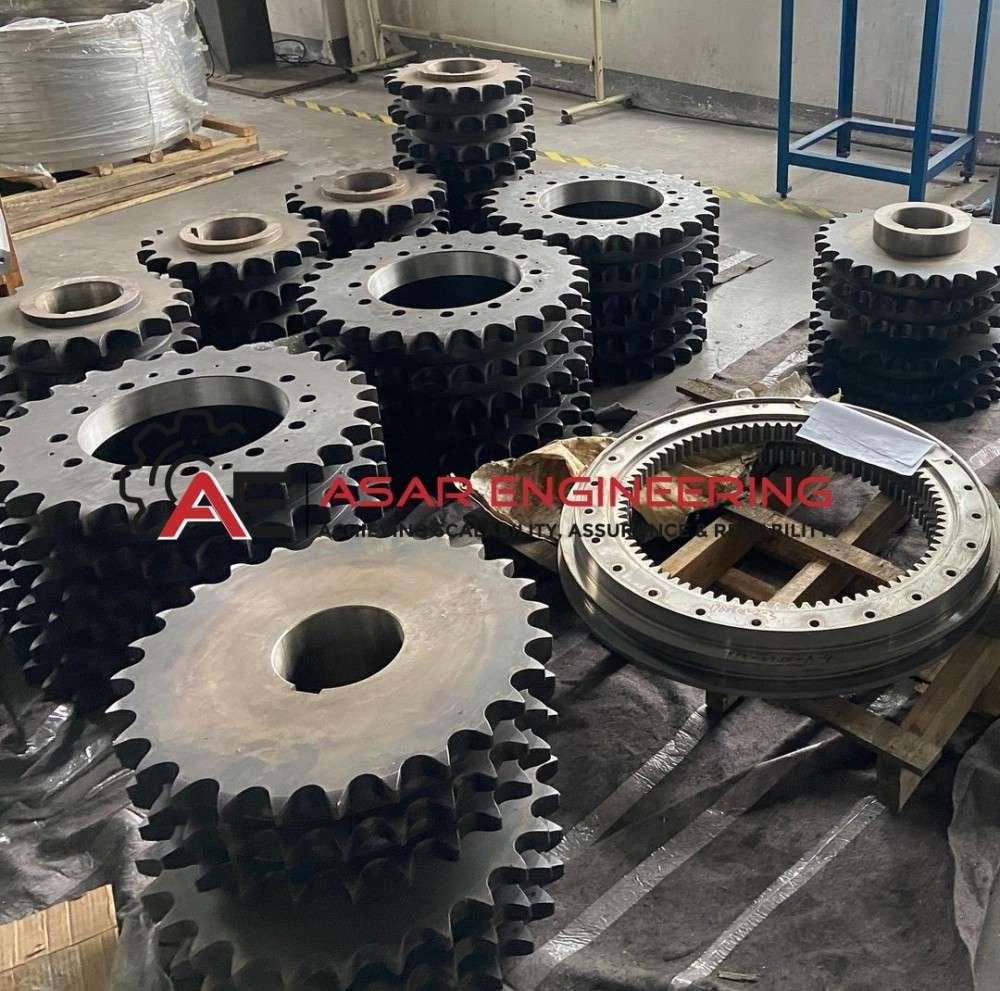
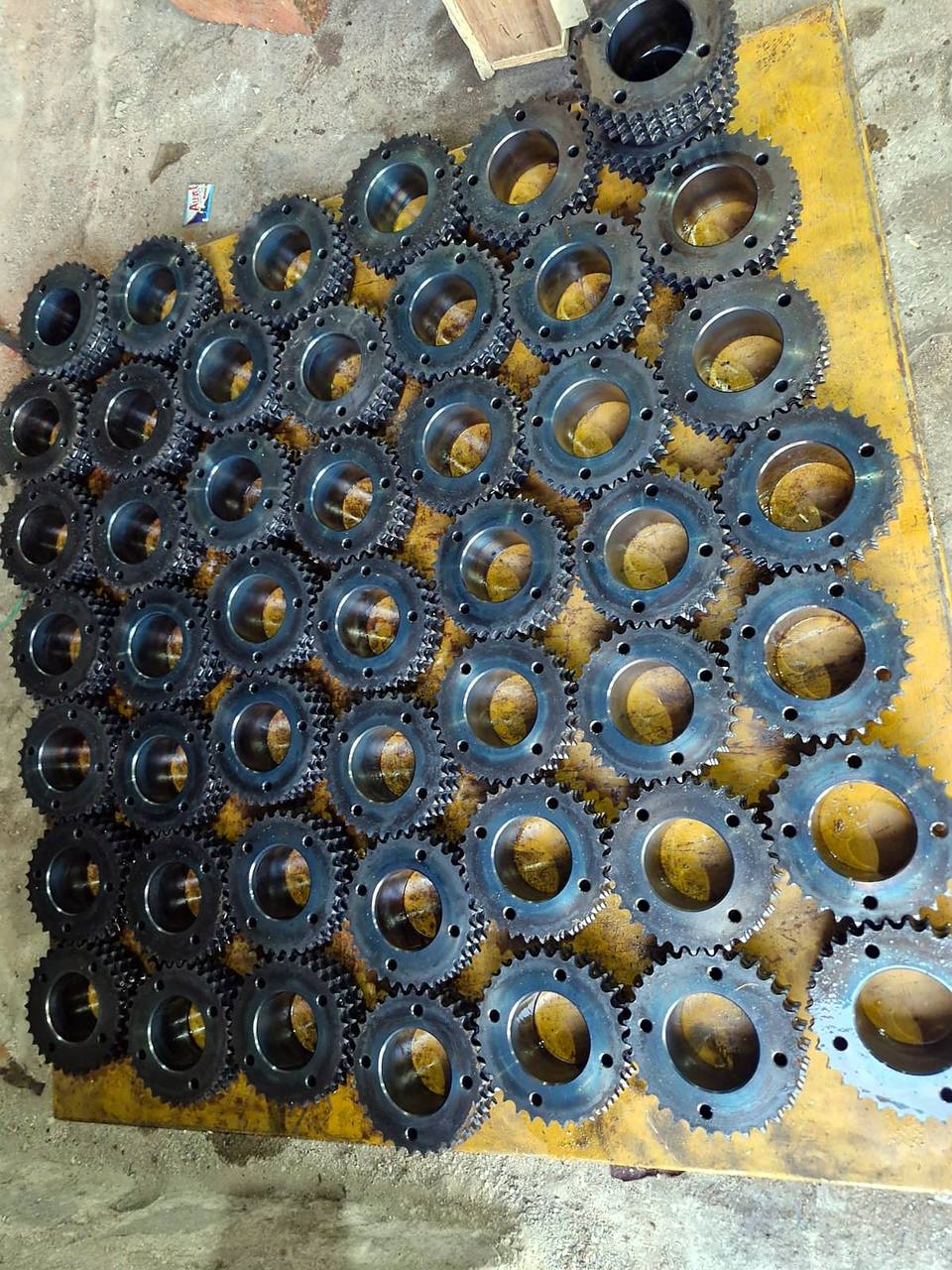
Our Industrial Chain Sprockets and Recent Work
Photos of parts made and dispatched from our unit, not stock images.


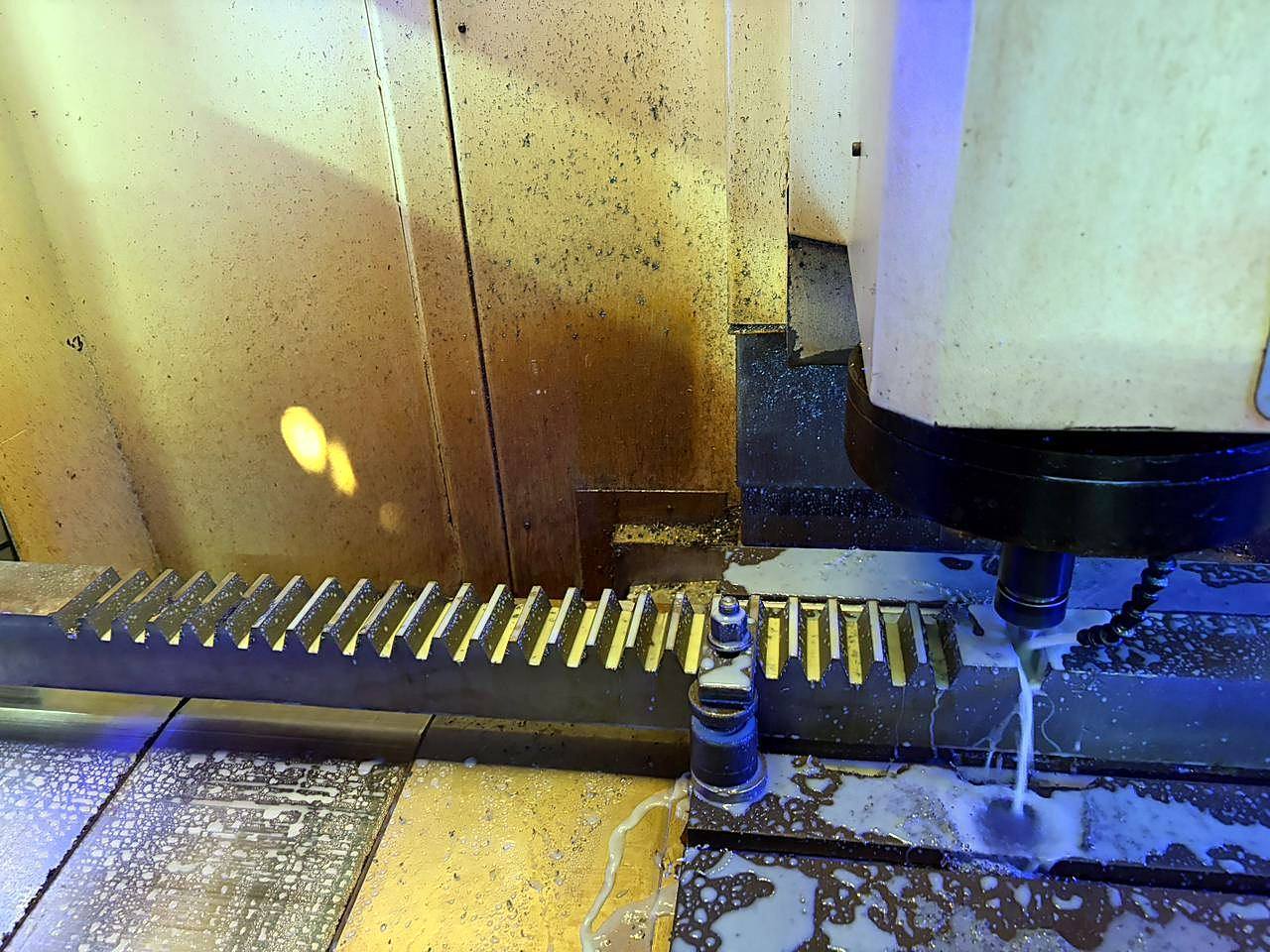


Machining Videos from Our Shop Floor
Short, uncut clips of gear cutting, hobbing and machining at our unit in Gujarat.


What Our Customers Say
Reviews left on our Google Business Profile, shown word for word.
I bought a single screw extruder from asar engineering pvt.ltd. It's been a game changer for my manufacturing process. The extruder is efficient, easy to operate and built to last. Their customer is excellent and they guided me well through installation and setup. Highly recommended!
Asar Engineering supplied gearbox components for one of our industrial applications. The dimensional accuracy, finishing, and overall performance were satisfactory. We particularly appreciated their technical understanding and ability to suggest suitable solutions based on our operating requirements.
We have been sourcing industrial gearboxes from Asar Engineering Pvt. Ltd. and are satisfied with the product quality and consistency. The gearboxes are well-built, perform reliably under continuous operation, and were supplied according to our required specifications. Their team was also responsive during technical discussions and order coordination.
Industrial Chain Sprocket FAQs
Questions buyers usually ask us before sending an enquiry for industrial chain sprocket.
How do I choose between Type A, B, C and D industrial chain sprockets?
Type A is a flat plate for bolting or welding into an assembly, Type B has a hub on one side and is the usual choice, Type C has hubs on both sides for heavier loads or wide sprockets, and Type D has an offset or bolted hub for awkward chain alignment. We select the industrial chain sprocket hub from your shaft, load and layout.
Why do sprocket teeth wear quickly and how can it be reduced?
Fast tooth wear on an industrial chain sprocket usually comes from a stretched chain, poor shaft alignment, dirt or abrasive material, or too little lubrication. Using carbon steel such as C45 or EN8 with induction-hardened teeth gives a hard wearing surface with a tough core; we do this hardening in-house. Replacing a worn chain with the sprocket also protects the new part.
What details should I give when asking for a chain sprocket quote?
Tell us the chain standard (ISO/BS or ANSI) and pitch, or the chain number, the number of strands and teeth, hub type, bore size with keyway or taper-lock/QD bush, material, whether teeth need hardening, and quantity. A drawing or old sprocket is ideal. For conveyor chain, give the chain make and pitch so the industrial chain sprocket tooth form matches.
Can you make a sprocket to match an old one from our conveyor?
Yes. We copy worn sprockets from a sample, measuring the pitch, tooth count, hub and bore, and cut the teeth at our Gandevi, Gujarat unit. If the chain is available, sending a length of it helps us confirm roller size and width. We can also change the bore, keyway or hub to suit a modified shaft on the replacement industrial chain sprocket.
Do you supply industrial chain sprockets in single pieces and for export?
Yes, we make industrial chain sprockets from a single replacement piece up to repeat batch orders, and supply them across India from Gujarat with a branch office in Mumbai. We are IEC registered and take export orders to customer drawings; for export, the chain standard must be stated clearly because it differs between countries. Sprockets are packed against impact and corrosion.
How We Make Your Industrial Chain Sprockets
- Send your requirementDrawing, sample or photos of the industrial chain sprocket, with the quantity you need.
- Technical check and quoteWe confirm material, hardness and tolerances, then send price and delivery time.
- Manufacturing and inspectionMade at our Gandevi unit; dimensions are checked before dispatch.
- DispatchPacked for road transport across India, or for export shipment.
Companies We Supply


























Need Industrial Chain Sprockets made to your drawing?
Send the drawing or a sample with the quantity. We supply across India and take export orders.