Induction Hardening Service & Job Work
Hard, wear-resistant surfaces on gear teeth, shafts and pins, with a tough core left underneath. Done in-house at Gandevi, Gujarat, for our own parts and for other workshops.
What Induction Hardening Does
An induction coil heats only the surface layer of a steel part, within seconds, and the part is then quenched. The heated layer becomes hard, while the core stays at its original toughness.
That combination is what a gear tooth or a shaft journal needs: a surface that resists wear and pitting, on a core that can take shock without cracking. Because only the working area is heated, distortion and scaling are lower than when the whole part goes through a furnace.
We use single-shot hardening, where the whole area to be hardened is heated at once in a shaped coil, which gives an even case on teeth and journals of a given size.
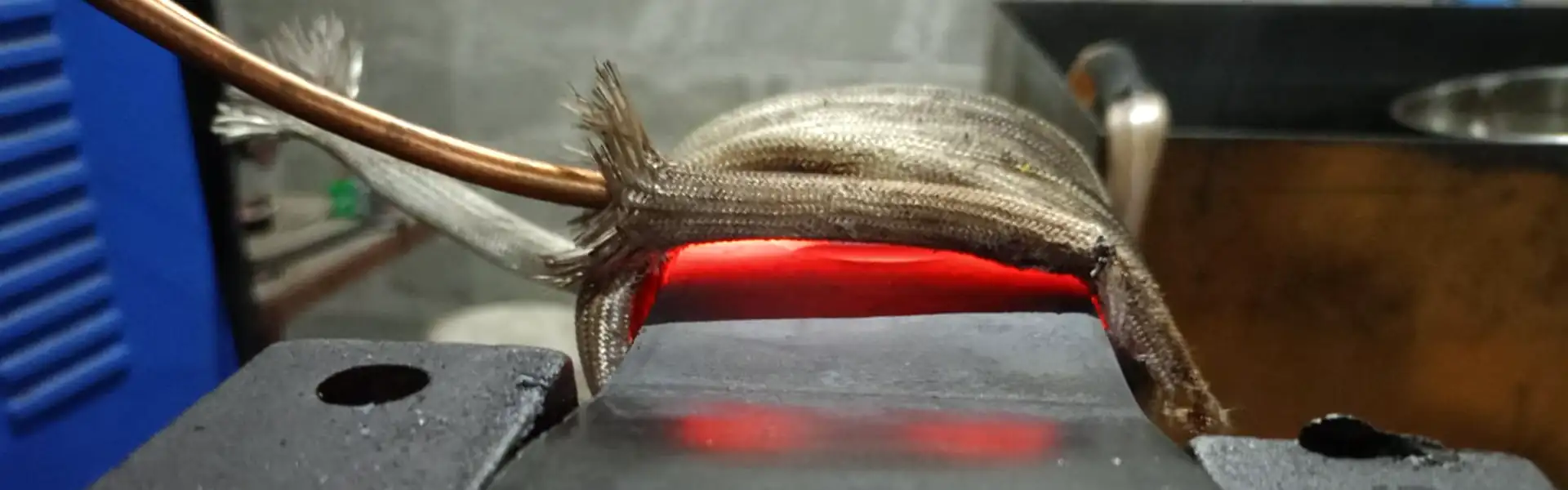
Induction hardening at our unit
A shaft heated in the coil, just before quenching.
Typical Parts and Surfaces
Most jobs are gear and shaft parts from power transmission equipment.
Gear and pinion teeth
Spur, helical and pinion shaft teeth, for wear and pitting resistance on the flanks.
Shaft journals and seats
Bearing seats, seal areas and journals on shafts, with the rest of the shaft left unhardened.
Sprocket teeth
Chain sprocket teeth for conveyors and elevators working in dust and grit.
Pins, rollers and bushes
Pins, rollers and wear sleeves where a hard surface extends the change interval.
Spline shafts
External splines on spline shafts that slide or carry shock torque.
Customer parts as job work
Parts machined elsewhere, sent to us only for hardening to your specification.
Benefits Over Through-Hardening
Through-hardening makes the whole part hard and can leave it brittle. Induction hardening puts the hardness only where the wear happens.
- Hard surface, tough core: resists wear and pitting while the core absorbs shock loads.
- Selective: only the teeth or journals are hardened; keyways and threads can stay soft for machining.
- Less distortion: short, local heating moves the part less than furnace treatment.
- Clean surface: very little scale, so less cleaning or grinding afterwards.
- Short cycle: seconds per part, which suits both single parts and batches.
Job work enquiry
What to Send for a Hardening Quote
- Drawing or clear photo of the part with dimensions
- Steel grade (for example EN8, EN9, EN19, EN24)
- Area to be hardened and areas to stay soft
- Required surface hardness and case depth
- Quantity, and whether it is a repeat batch
Parts ready for hardening?
Send the details and we will confirm the process, price and turnaround time.
Induction Hardening FAQs
Common questions from workshops sending us parts for hardening.
Which parts can you induction harden?
Gear teeth, pinion shafts, journals and bearing seats, sprocket teeth, pins, rollers and similar wear surfaces. Send the drawing and we will confirm whether the geometry suits our coil and fixture.
Which steels are suitable for induction hardening?
Medium-carbon and alloy steels harden well, for example EN8, EN9, EN19 and EN24. Low-carbon steels such as mild steel do not reach useful hardness this way. If you are unsure of the grade, tell us and we will advise.
How do you agree the hardness and case depth?
Before the job we agree the target surface hardness, the case depth and the areas to be left soft, based on your drawing and the steel grade. Parts are checked after hardening against what was agreed.
Do you only harden parts you make?
No. We harden our own gears and shafts and also take induction hardening as job work for other workshops and machine builders. Parts can be sent to our unit at Gandevi, Gujarat.
What should I send for a quote?
A drawing or photo of the part, the steel grade, the area to be hardened, the hardness and case depth required, and the quantity. For repeat batches, one sample part helps us set up the coil.