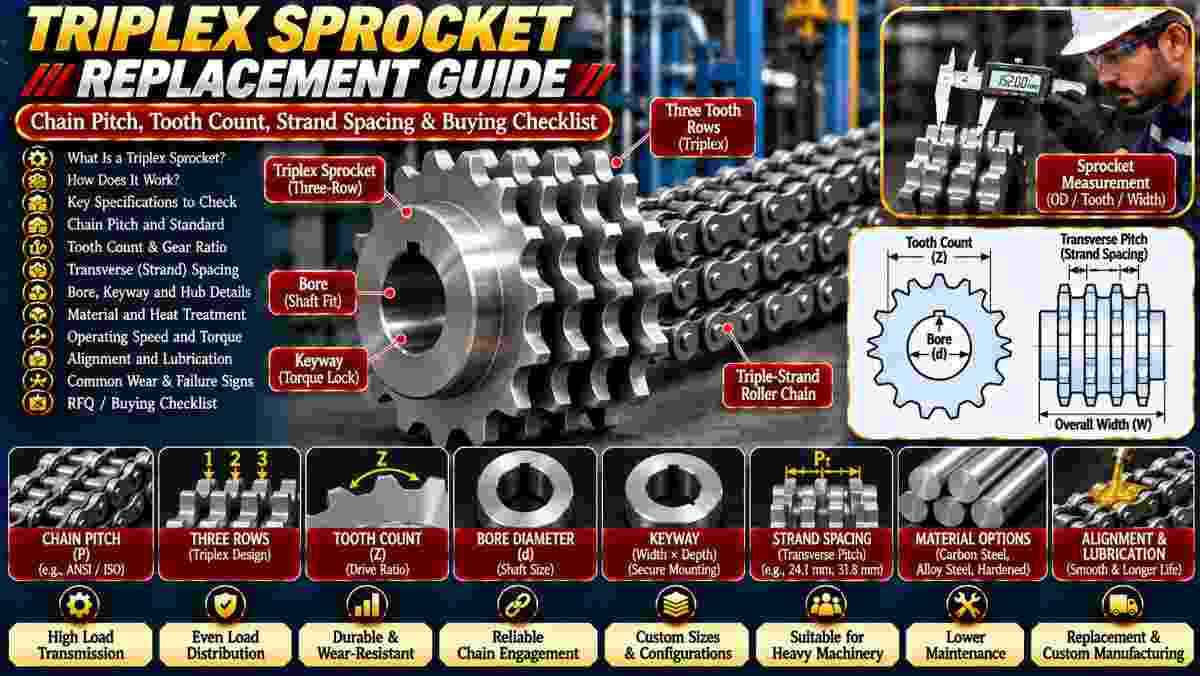
Are you replacing a worn triplex sprocket in an industrial conveyor, transmission system, or heavy-duty machine? Incorrect tooth dimensions, chain spacing, or shaft connections can cause uneven loading, excessive wear, and unexpected downtime.
Triplex sprocket replacement specifications should include chain pitch, tooth count, transverse strand spacing, bore diameter, keyway dimensions, hub configuration, material grade, and operating conditions.
Asar Engineering Pvt. Ltd. offers industrial sprockets and power transmission components for machinery applications.
What Is an Industrial Triplex Sprocket?
A triplex sprocket is a three-row toothed wheel designed to engage a compatible triple-strand roller chain and transmit mechanical power.
Unlike simplex and duplex sprockets, a triplex sprocket has three parallel tooth rows.
Common applications include:
-
Heavy-duty conveyor systems.
-
Industrial processing machinery.
-
Agricultural equipment.
-
Material-handling drives.
-
Manufacturing production lines.
-
High-load power transmission systems.
Explore Triplex Sprockets for product information.
How Does a Triplex Sprocket Work?
A triplex sprocket transmits power when its three rows of teeth engage the corresponding rollers of a triple-strand chain.
As the driving sprocket rotates, it moves the chain and transfers torque to the driven sprocket.
Correct tooth geometry and alignment are necessary to distribute loading between the strands.
What Is the Difference Between Simplex, Duplex, and Triplex Sprockets?
Simplex sprockets have one tooth row, duplex sprockets have two, and triplex sprockets have three.
These configurations correspond to single-, double-, and triple-strand roller chains.
Multi-strand drives can transmit greater loads when properly designed.
However, capacity is not necessarily proportional to strand count because load sharing and operating conditions affect performance.
Why Is Chain Pitch Important for Triplex Sprockets?
Chain pitch is the center-to-center distance between consecutive roller chain pins and must match the sprocket's tooth geometry.
When ordering, confirm:
-
Chain standard.
-
Chain designation.
-
Longitudinal pitch.
-
Roller diameter.
-
Inner link width.
Do not identify a sprocket using chain pitch alone.
What Is Transverse Pitch in a Triplex Chain?
Transverse pitch is the center-to-center distance between adjacent chain strands and determines the required spacing between sprocket tooth rows.
A triplex sprocket must match both the longitudinal chain pitch and transverse strand spacing.
Different chain series can have incompatible dimensions.
Always provide the complete chain designation.
How Do You Determine the Correct Sprocket Tooth Count?
Tooth count influences sprocket diameter, drive ratio, chain articulation, and operating behavior.
For a conventional chain drive:
Speed Ratio = Driven Sprocket Teeth ÷ Driving Sprocket Teeth
For example, a 20-tooth driving sprocket and a 40-tooth driven sprocket provide a theoretical 2:1 speed reduction.
Replacement tooth counts should match the approved drive design.
Which Triplex Sprocket Dimensions Should You Measure?
Critical measurements include tooth count, sprocket diameter, tooth-row spacing, overall width, bore size, and hub dimensions.
Record:
-
Number of teeth.
-
Chain pitch.
-
Tooth-row spacing.
-
Outside diameter.
-
Overall sprocket width.
-
Bore diameter.
-
Hub diameter and length.
-
Keyway dimensions.
An existing drawing or component sample is particularly useful for replacement orders.
Why Are Bore and Keyway Dimensions Important?
Bore and keyway dimensions determine how the sprocket fits the shaft and transmits torque.
Confirm the shaft diameter, bore tolerance, keyway width, keyway depth, and locking arrangement.
Incorrect dimensions can lead to loose connections, assembly difficulties, or shaft damage.
Which Materials Are Suitable for Triplex Sprockets?
Material selection depends on transmitted loads, wear requirements, environmental exposure, and expected operating life.
Common options include:
Some applications require hardened sprocket teeth to improve wear resistance.
Confirm the material and heat-treatment requirements with the supplier.
How Do Operating Speed and Torque Affect Sprocket Selection?
Operating speed and torque determine the mechanical demands placed on the chain and sprocket assembly.
Important considerations include:
-
Motor power.
-
Input RPM.
-
Normal operating torque.
-
Starting torque.
-
Shock loading.
-
Duty cycle.
The complete chain drive should be evaluated according to manufacturer ratings and applicable service factors.
Why Are Alignment and Lubrication Important?
Correct alignment and lubrication help maintain smooth chain engagement and reduce premature component wear.
Inspect shaft alignment, sprocket positioning, chain tension, and lubrication conditions.
Misalignment may cause uneven loading across the three chain strands.
Use the lubrication method recommended for the selected chain and operating environment.
What Causes Premature Triplex Sprocket Wear?
Premature wear commonly results from chain elongation, excessive loading, poor lubrication, misalignment, or abrasive contamination.
Warning signs include:
Inspect the chain and mating sprockets together before replacing components.
What Should You Check Before Ordering a Replacement Triplex Sprocket?
A replacement triplex sprocket must match the existing chain series, tooth geometry, strand spacing, and mounting configuration.
Check the original sprocket designation, tooth count, bore, keyway, material, hub dimensions, and operating requirements.
Avoid choosing a replacement based only on outside diameter.
What Factors Affect Triplex Sprocket Prices?
Prices depend on sprocket size, tooth count, material grade, machining complexity, heat treatment, and customization.
Additional factors include:
Compare quotations using identical technical specifications.
What Should You Include in a Triplex Sprocket RFQ?
A complete quotation request should identify the chain system, sprocket dimensions, shaft connection, operating loads, and required quantity.
Provide:
-
Machinery application.
-
Chain standard and designation.
-
Chain pitch.
-
Required tooth count.
-
Transverse strand spacing.
-
Bore diameter.
-
Keyway dimensions.
-
Hub configuration.
-
Material and heat treatment.
-
Motor power and operating RPM.
-
Normal and peak loads.
-
Technical drawings, quantity, and delivery location.
These details help suppliers evaluate replacement compatibility.
Why Should Buyers Consider Asar Engineering?
Asar Engineering offers triplex sprockets and other industrial power transmission components for machinery applications.
Buyers can enquire about replacement or custom sprockets using existing component drawings and technical specifications.
Explore Triplex Sprockets for product information.
Confirm manufacturing capabilities, material options, dimensions, inspection requirements, and product availability before purchasing.
What Are the Most Frequently Asked Questions About Triplex Sprockets?
Common questions concern chain compatibility, load capacity, dimensions, customization, and replacement requirements.
Can a Triplex Sprocket Be Used With a Duplex Chain?
No. Conventional triplex sprockets are designed for compatible three-strand roller chains.
Do Triplex Sprockets Carry Three Times the Load of Simplex Sprockets?
Not necessarily. Actual capacity depends on multi-strand load-sharing factors, chain ratings, operating speed, and drive conditions.
Are ANSI and British Standard Triplex Sprockets Interchangeable?
Not automatically. Chain geometry, transverse pitch, roller dimensions, and tooth specifications must be checked.
Can Triplex Sprockets Be Custom Manufactured?
Custom tooth counts, bores, keyways, materials, and hub configurations may be available depending on manufacturing capabilities.
Should You Replace a Worn Chain and Sprocket Together?
Inspect both components. Severely worn or incompatible mating components may cause premature wear after replacement.
How Can You Request Triplex Sprockets From Asar Engineering?
You can request a quotation by sharing the chain designation, pitch, tooth count, strand spacing, shaft dimensions, material, and required quantity.
For replacement applications, include an existing sprocket sample, photographs, or an approved technical drawing.
Explore Triplex Sprockets or visit Asar Engineering to discuss your requirements.
Technical Note: Final triplex sprocket selection should follow compatible chain standards, manufacturer load ratings, approved drawings, and engineering calculations.